
While the market follows the billion-dollar movements of technology giants, a more discreet transformation is beginning to gain momentum among small Brazilian companies. Automation tools, intelligent agents and low-code platforms are changing entire operations without requiring large IT structures. In 2026, the silent adoption of AI by SMEs has become one of the most strategic moves in the digital economy.
Automation is no longer exclusive to large companies

For many years, enterprise automation solutions were associated with large corporations with robust technology teams. In 2026, this scenario quickly changed.
Tools based on Artificial Intelligence, integration via API and SaaS platforms have started to drastically reduce operational costs for small businesses. Today, local businesses can automate:
- customer service;
- issuance of invoices;
- CRM;
- marketing campaigns;
- financial analysis;
- stock control;
- generation of reports.
In practice, this means that small companies are able to compete with much larger structures using accessible software and lean operating models.
The impact appears mainly in sectors such as:
- e-commerce;
- accounting offices;
- marketing agencies;
- clinics;
- real estate agencies;
- small retailers;
- service companies.
In many cases, a single operator can now perform tasks that previously required entire teams.
In addition to cost reduction, operational speed became a competitive differentiator. Companies that automate processes are able to respond to customers faster, automatically generate proposals and reduce human errors.
This advance follows a broader movement in the Brazilian corporate market, where intelligent agents and operational automation are beginning to replace traditional software in several areas of companies.
To understand how this transformation is happening, it is also worth checking out:
- Companies begin to replace traditional software with AI agents
- Companies double investments in corporate AI and Brazil accelerates adoption of intelligent agents
- How companies use AI to automate processes
Low-code platforms accelerate AI adoption in SMEs

Another decisive factor for this transformation is the growth of low-code and no-code platforms.
These solutions allow you to create automations without the need for advanced programming. Instead of relying exclusively on developers, small teams can integrate systems using visual interfaces.
Modern tools now allow:
- create automated flows;
- integrate WhatsApp with CRM;
- automate emails;
- generate intelligent reports;
- connect marketplaces;
- use chatbots with generative AI.
This movement also favors Brazilian companies that have a limited budget for technology.
Instead of investing thousands of dollars in custom development, many businesses started to operate with affordable monthly subscriptions and ready-made automations.
Additionally, the popularization of generative AI has lowered the barrier to entry for content creation, support, and productivity.
Today, small businesses use AI to:
Content production
Smart tools help generate product descriptions, articles, ads and texts for social media.
Automated service
Chatbots integrated into WhatsApp can respond to customers 24 hours a day.
Operational management
Intelligent software already identifies financial patterns, bottlenecks and optimization opportunities.
This advancement creates a new profile of a digital company: smaller, leaner and highly automated operations.
The trend also appears in other strategic areas of the market:
- WhatsApp Business gains automation with AI and becomes a central tool for small businesses in Brazil
- AI for small businesses: automated processes accelerate productivity
- CRM with AI and automation is changing business processes in companies
The risk for companies that ignore the new wave of automation
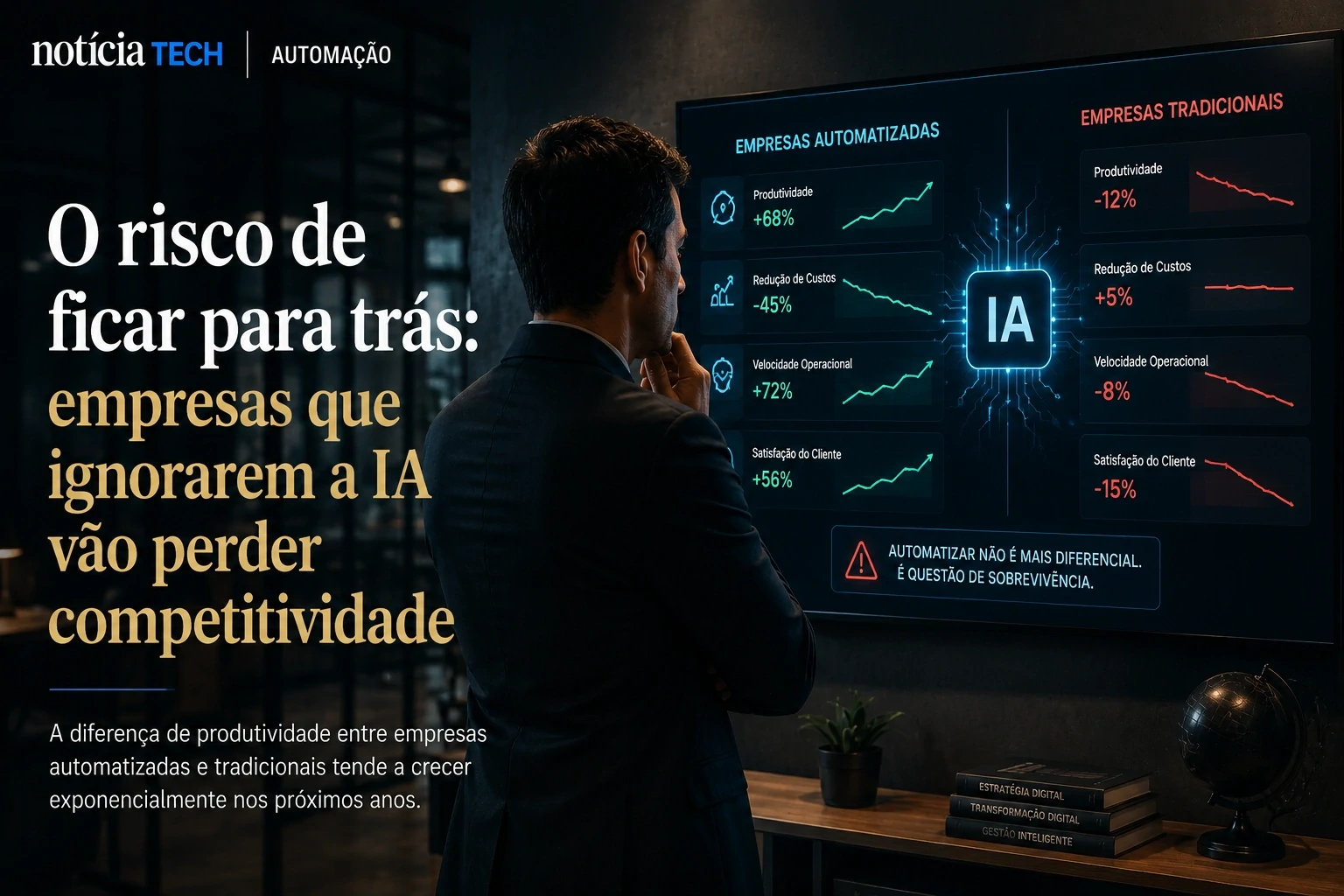
Although AI adoption is still in its early stages in many small Brazilian companies, the market is already beginning to create a new competitive divide.
On the one hand, companies that quickly automate processes.
On the other, businesses that continue to operate with slow, manual and poorly scalable structures.
The productivity gap tends to grow in the coming years.
Automated companies can:
- reduce fixed costs;
- operate with fewer employees;
- serve more customers;
- respond faster;
- scale operations without expanding teams at the same rate.
Meanwhile, traditional companies are starting to face difficulty competing in speed and operational efficiency.
The movement is reminiscent of other major technological transitions of the past, but with one important difference: this time, adoption can happen much faster.
The combination of generative AI, affordable automation, and simplified integration is accelerating digital transformation for even extremely small businesses.
Companies that take time to adapt operations may face the same problem observed in other recent technological waves: gradual loss of competitiveness, reduction in margins and difficulty in keeping up with more efficient competitors.
This scenario is already beginning to worry executives and managers in several sectors:
- Companies postpone investments in AI and lose competitiveness
- Anthropic quadruples revenue with AI and sends a message to the market: companies that delay may be left behind
- Why companies are redesigning internal processes with AI and not just automating tasks
In the coming years, the discussion will likely stop being “is it worth using AI?” to transform into “how to survive without intelligent automation?”.
Comentários
Os comentários utilizam autenticação via GitHub para manter um ambiente mais qualificado, seguro e livre de spam.
Entrar ou criar conta no GitHub