
As businesses move beyond a single chatbot and begin operating dozens of specialized AI agents, a new challenge emerges: coordinating all of these intelligent systems. This is exactly where AI Orchestration evolves from a technical concept into a strategic capability for enterprise digital transformation.
What Is AI Orchestration and Why It Matters
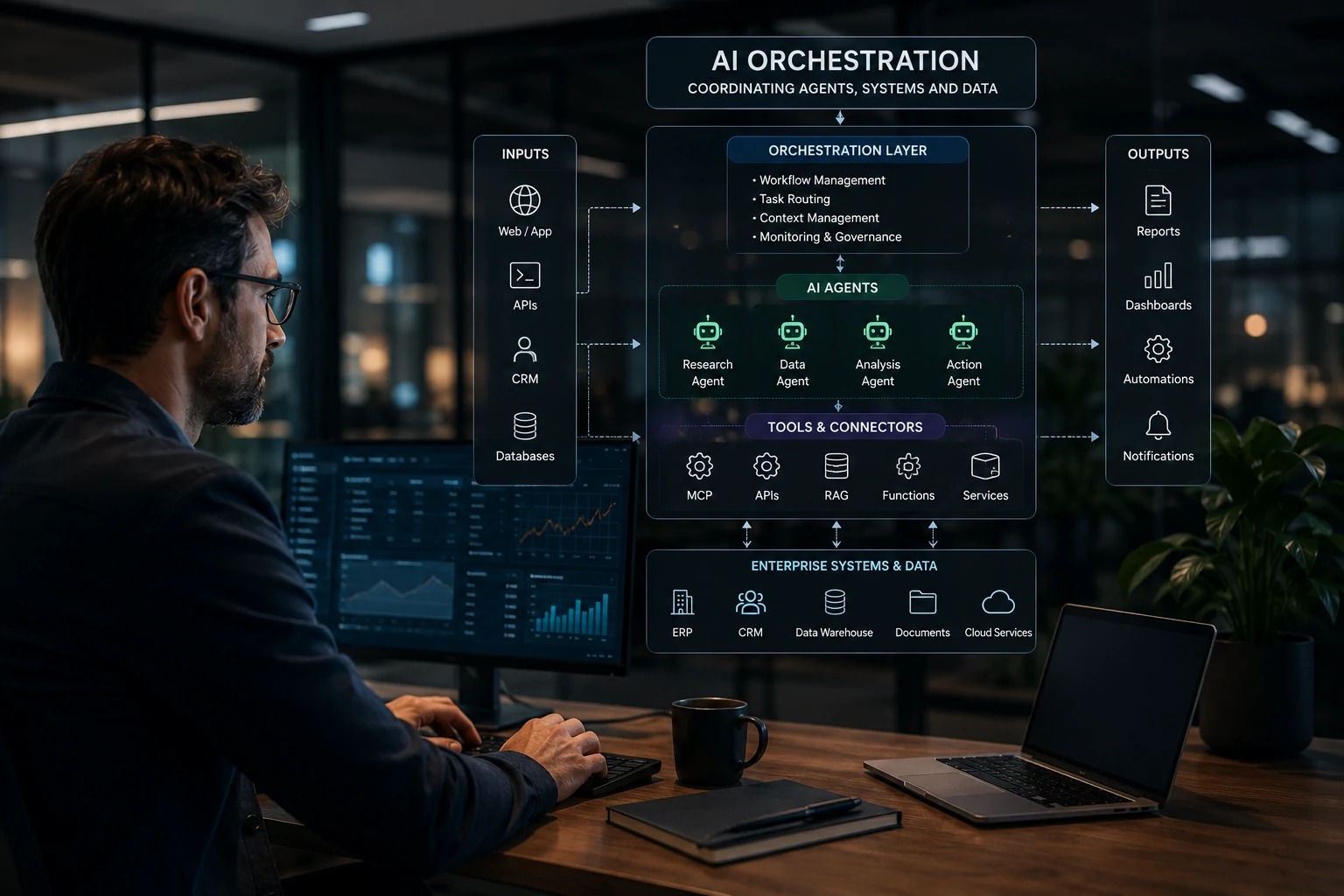
An orchestration layer coordinates specialized AI agents, enterprise applications and language models within a single operational workflow.
During the early years of Generative AI, most organizations focused on selecting the best large language model, whether ChatGPT, Claude or Gemini.
Today, that discussion is becoming less important.
The real challenge has shifted toward connecting multiple AI systems, enterprise applications and business workflows into one coordinated architecture.
That is precisely the role of AI Orchestration.
Instead of allowing every AI agent to work independently, an orchestration platform distributes responsibilities, prioritizes tasks, monitors execution and ensures every stage of a workflow happens in the correct sequence.
A layer above AI models
AI Orchestration does not replace language models.
Instead, it operates above them.
While a model generates answers, the orchestration layer decides:
- which AI agent should execute a task;
- which enterprise application should be queried;
- which documents should provide context;
- when another specialized agent should continue the workflow.
This approach mirrors how successful organizations operate, where specialists collaborate under centralized coordination rather than working independently.
Why AI Orchestration is gaining momentum
As organizations deploy more AI agents, they begin facing new operational problems, including:
- duplicated work;
- inconsistent outputs;
- fragmented context;
- poor traceability;
- weak governance.
AI Orchestration addresses these issues by coordinating multiple intelligent agents within a structured operational framework, making enterprise AI more reliable, scalable and predictable.
How an AI Orchestration Architecture Works
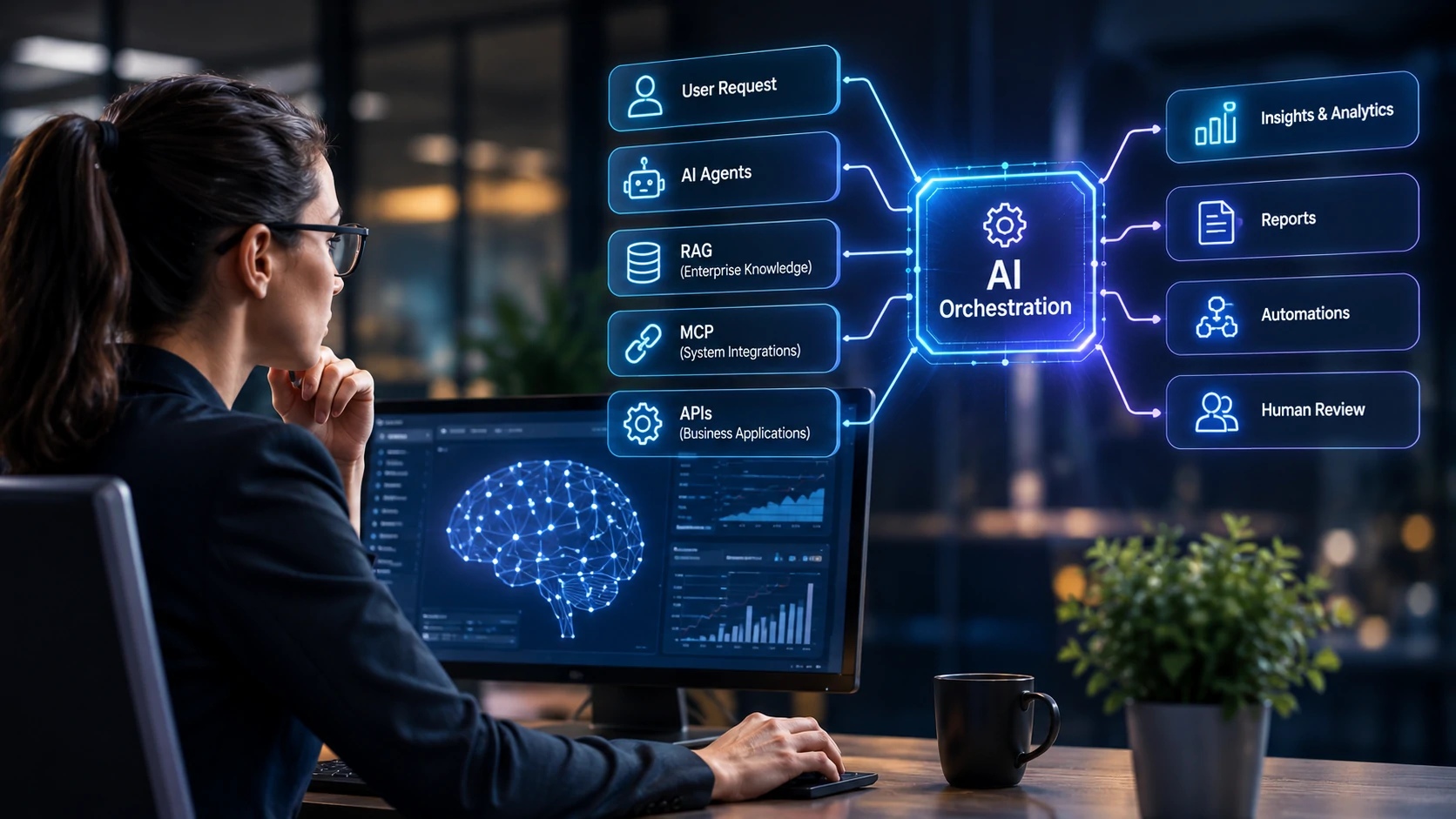
Enterprise data flows through specialized AI agents before returning valuable insights or triggering business actions.
In a modern enterprise architecture, AI Orchestration functions as the operational control center.
It receives an incoming request and determines the optimal execution path until the desired business outcome is achieved.
A practical business workflow
Imagine a company receiving a new sales inquiry.
A typical orchestrated workflow may look like this:
- A website form triggers an automation.
- An AI agent analyzes the customer’s request.
- Another agent checks the CRM.
- A third agent retrieves internal knowledge through RAG.
- MCP securely connects AI with enterprise systems.
- Another agent prepares a commercial proposal.
- The proposal is sent to a sales representative for final human approval.
No individual AI agent understands the entire business process.
Each one performs only its specialized responsibility.
The coordination of the complete workflow is handled by the AI Orchestration layer.
Example of a production prompt
You are responsible for qualifying new B2B leads.

Context:
- B2B company
- CRM integration available
- Customer history accessible

Objective:
Classify each lead as High, Medium or Low potential.

Output format:
- Score
- Business justification
- Recommended next action
This type of specialization reduces unnecessary processing, improves consistency and enables AI agents to deliver significantly higher-quality business outcomes.
AI Orchestration Does Not Replace MCP, RAG or AI Agents
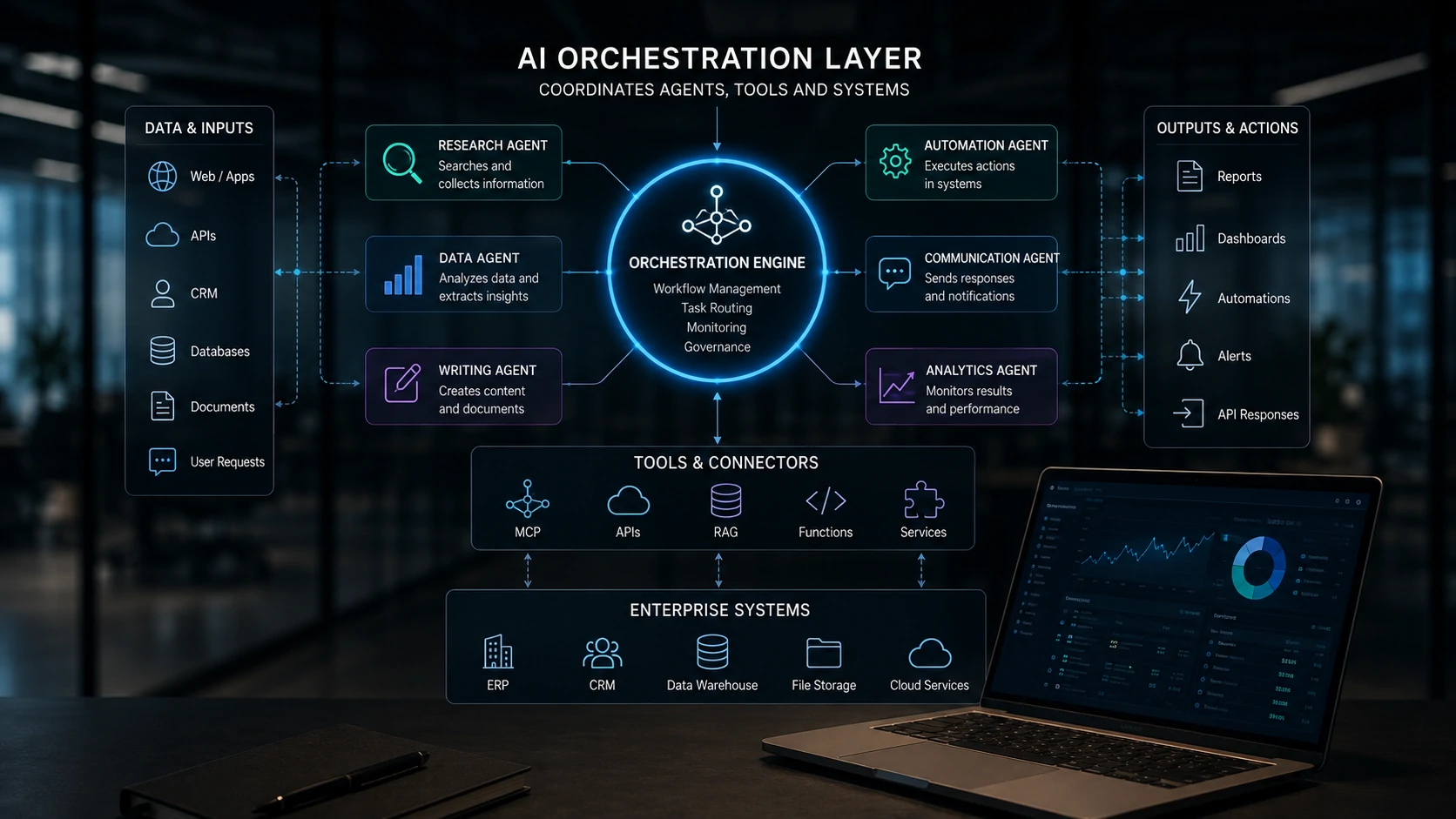
Within a modern enterprise AI stack, AI Orchestration coordinates complementary technologies rather than replacing them.
One of the biggest misconceptions surrounding AI Orchestration is the belief that it competes with MCP, RAG or AI Agents.
In reality, each technology solves a different problem within the enterprise AI ecosystem.
Their combined use creates a scalable architecture capable of supporting complex business operations instead of isolated AI interactions.
The role of each technology
A simple way to understand the architecture is to separate every component by its primary responsibility.
- AI Agents execute specialized tasks.
- RAG provides contextual enterprise knowledge.
- MCP securely connects AI models with enterprise software.
- APIs exchange information between business applications.
- AI Orchestration coordinates every component across the entire workflow.
This layered architecture improves scalability, governance, maintainability and operational reliability.
It is also why major enterprise AI vendors are increasingly delivering orchestration platforms rather than standalone language models.
Human-in-the-Loop remains essential
Even highly autonomous AI systems still require human supervision.
This principle is widely known as Human-in-the-Loop (HITL).
Typical approval stages include:
- contract validation;
- payment authorization;
- commercial proposal review;
- legal decisions;
- compliance and risk analysis.
AI Orchestration allows organizations to define exactly where human intervention is required before a workflow continues.
Rather than eliminating people from business processes, orchestration makes collaboration between humans and AI significantly safer and more predictable.
How Businesses Can Start Implementing AI Orchestration
Adopting AI Orchestration does not require replacing an organization’s entire technology stack.
Most successful implementations begin by automating a single high-value business process before gradually expanding to additional workflows.
An effective starting point is identifying repetitive processes that already involve documents, enterprise applications and structured decision-making.
A practical implementation roadmap
Many organizations follow a phased deployment strategy.
- Map an existing business process.
- Identify tasks that can be delegated to specialized AI agents.
- Connect internal knowledge using RAG.
- Integrate enterprise systems through MCP or APIs.
- Deploy an orchestration layer that coordinates every AI agent involved.
This modular approach reduces implementation risk because each new workflow builds on components that have already been validated.
For organizations interested in connecting enterprise systems with AI, the guide How to Build an MCP Server to Connect AI with Enterprise Systems provides a practical starting point.
Readers looking for a broader understanding of enterprise AI architecture can also explore Enterprise AI Architecture: Complete Guide to MCP, RAG, AI Agents, Workflows, Copilots and APIs.
The future belongs to intelligent coordination
Over the coming years, competitive advantage will likely depend less on which AI model a company chooses and more on how effectively multiple intelligent systems collaborate.
Organizations will increasingly operate ChatGPT, Claude, Gemini, open-weight models and specialized AI agents simultaneously.
The real differentiator will be the orchestration layer capable of coordinating every component into a unified business operation.
In many ways, AI Orchestration is positioned to become for enterprise artificial intelligence what ERP systems became for enterprise resource planning: the operational foundation that connects previously isolated technologies into a single, scalable ecosystem.
For executives, technology leaders and organizations planning long-term AI adoption, understanding AI Orchestration today is no longer simply a technical advantage—it is becoming a strategic business requirement.
Comentários
Os comentários utilizam autenticação via GitHub para manter um ambiente mais qualificado, seguro e livre de spam.
Entrar ou criar conta no GitHub