
As organizations deploy multiple AI models simultaneously, a new challenge emerges: coordinating specialized agents, enterprise applications and automated workflows without increasing operational complexity. This is precisely where AI Orchestration becomes a strategic component of modern digital transformation.
What Is AI Orchestration and Why It Matters
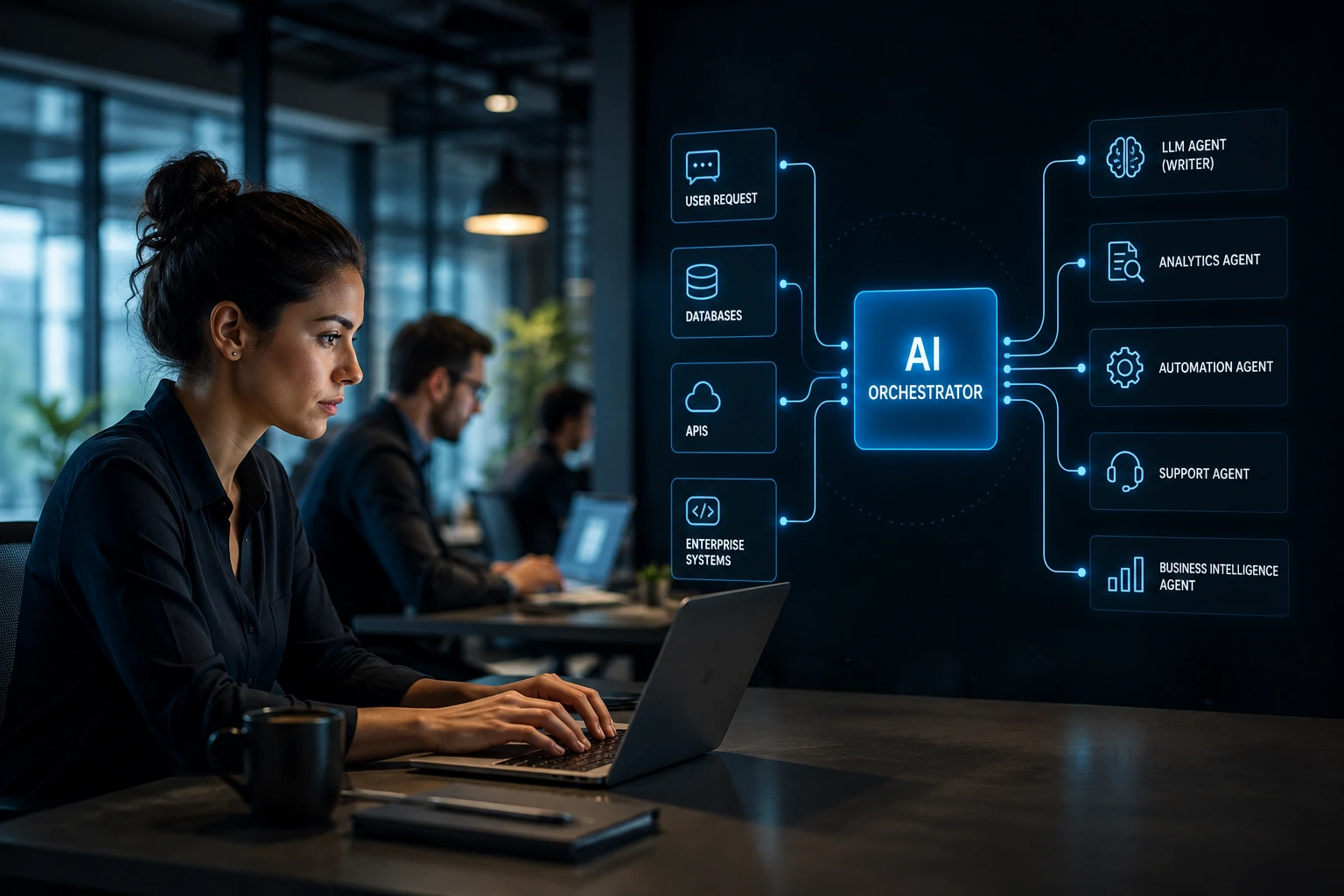
An orchestration platform coordinates specialized AI agents, enterprise systems and language models inside a unified operational workflow.
The widespread adoption of ChatGPT, Claude, Gemini, open-source models and autonomous AI agents has made many organizations realize that simply deploying multiple AI systems does not automatically create an intelligent business process.
AI Orchestration addresses this challenge by coordinating models, agents, APIs, enterprise databases and business applications within a single decision-making architecture.
The conversation is no longer centered on choosing the best AI model. Instead, companies are asking which agent should perform each task, when it should be activated and how information should flow between every component involved.
Beyond Simple API Integrations
Unlike traditional system integrations, AI Orchestration introduces an intelligent coordination layer capable of determining which model or agent should execute each business activity.
A typical enterprise workflow may simultaneously use:
- GPT to generate reports;
- Claude to review legal documents;
- a private local model to process confidential information;
- an internal agent connected to the ERP;
- another agent responsible for CRM operations.
Each system contributes its own specialization while the orchestrator manages the overall workflow.
Similar to the Rise of Enterprise Resource Planning
Just as ERP platforms unified disconnected business departments, AI Orchestration is becoming the architectural layer that unifies previously isolated AI ecosystems.
This evolution expands concepts previously explored by Notícia Tech, including How to Build an MCP Server to Connect AI with Enterprise Systems and Why AI Process Automation Is Replacing Traditional Business Automation. Together, these technologies demonstrate that the future of enterprise automation depends increasingly on the intelligent coordination of AI agents rather than isolated automation tools.
How a Modern AI Orchestration Architecture Works

Multiple AI agents exchange context and collaborate under the supervision of a centralized orchestration engine.
In practice, AI Orchestration functions as the operational controller responsible for distributing work across specialized components.
Instead of relying on a single language model to perform every task, organizations assign specific responsibilities to dedicated AI agents, improving quality, scalability and operational efficiency.
Example of an Enterprise Workflow
A typical orchestration pipeline may follow this sequence:
- A web form generates a new lead.
- The orchestrator receives the event.
- One AI agent retrieves CRM information.
- Another agent gathers public company data.
- A language model summarizes the collected information.
- Another AI model drafts a personalized sales email.
- The CRM automatically stores the completed result.
Rather than having one model perform every step, multiple specialized agents collaborate within a coordinated workflow.
Example Prompt Used by the Orchestrator
Objective:
Prepare an executive sales briefing.

Context:
Use CRM information, publicly available company data and previous customer interactions.

Expected Output:
- Company overview
- Business opportunities
- Potential objections
- Recommended next actions
This orchestration approach significantly reduces repetitive work while improving both consistency and response quality.
Human-in-the-Loop Remains Essential
Even sophisticated AI architectures have limitations.
Models may misunderstand business context, rely on outdated information or occasionally generate inaccurate recommendations.
For this reason, mature organizations continue adopting a Human-in-the-Loop strategy, ensuring that business-critical decisions remain subject to human validation before execution.
This combination of intelligent automation and human supervision is what distinguishes enterprise-grade AI implementations from experimental AI projects.
Which Platforms Are Leading AI Orchestration for Businesses

AI orchestration platforms connect autonomous agents, enterprise applications and APIs into a unified operational environment.
The rapid growth of AI Orchestration has fueled the emergence of platforms specifically designed to coordinate AI agents, enterprise workflows and software integrations.
Although dozens of solutions are available, a handful of platforms have become industry references for organizations building production-grade AI systems.
The Most Widely Adopted Platforms
Among today’s leading solutions are:
- LangGraph, designed for sophisticated multi-agent architectures.
- CrewAI, focused on collaborative AI agent ecosystems.
- n8n, widely adopted for AI-powered workflow automation.
- Make, known for its visual automation builder and extensive integrations.
- Microsoft Copilot Studio, built for organizations operating within the Microsoft ecosystem.
- OpenAI Agents SDK, enabling developers to build enterprise AI agents powered by OpenAI models.
While each platform offers different capabilities, they all pursue the same objective: enabling specialized AI agents to collaborate efficiently within business workflows.
The Logic Behind Orchestration
Regardless of the technology stack, AI Orchestration generally follows a similar execution pattern:
- Receive a business event.
- Analyze the operational context.
- Select the most appropriate AI agent for each task.
- Share context across agents.
- Consolidate outputs.
- Record execution data for monitoring and continuous improvement.
This orchestration layer minimizes duplicated work while improving scalability, reliability and operational efficiency.
Governance Becomes Part of the Architecture
As organizations deploy dozens—or even hundreds—of AI agents, governance becomes just as important as automation itself.
Businesses must manage:
- access permissions;
- sensitive enterprise data;
- audit trails;
- prompt version control;
- execution costs;
- performance monitoring.
This architectural evolution aligns closely with the concepts explored in What Is AI Governance and Why Businesses Will Need It in the Coming Years, reinforcing that enterprise AI success depends not only on intelligent automation but also on security, compliance and governance. :contentReference[oaicite:0]{index=0}
Why AI Orchestration Is Becoming the Next Strategic Layer of Enterprise AI
During the early years of Generative AI, the industry focused primarily on identifying the most capable language model.
That discussion is gradually becoming less important.
Today, competitive advantage increasingly depends on an organization’s ability to coordinate multiple specialized AI models within integrated business processes.
The Competitive Focus Shifts from Models to Architecture
Forward-looking organizations are no longer asking:
“Which AI model should we use?”
Instead, they ask:
“How can all of our AI agents collaborate to produce better business outcomes?”
This represents a transformation similar to the transition from isolated business software to fully integrated enterprise platforms that reshaped corporate IT over the past several decades.
Workflow Architecture Becomes the Real Competitive Asset
Individual AI models can be replaced as technology evolves.
A well-designed AI Orchestration architecture, however, accumulates operational knowledge, business rules, integrations, execution history and organizational expertise over time.
That accumulated intelligence becomes one of the organization’s most valuable digital assets.
Companies investing early in orchestration will be better positioned to adopt future AI models, reduce migration costs and continuously improve their AI capabilities without rebuilding their entire operational infrastructure.
Rather than competing over which individual model produces the best answer, the enterprise AI market is evolving toward a future where the greatest competitive advantage lies in intelligently coordinating dozens of AI agents, business applications and enterprise systems. In this new landscape, AI Orchestration is no longer an optional technology—it is becoming the operational foundation for the next generation of AI-driven digital transformation.
Comentários
Os comentários utilizam autenticação via GitHub para manter um ambiente mais qualificado, seguro e livre de spam.
Entrar ou criar conta no GitHub