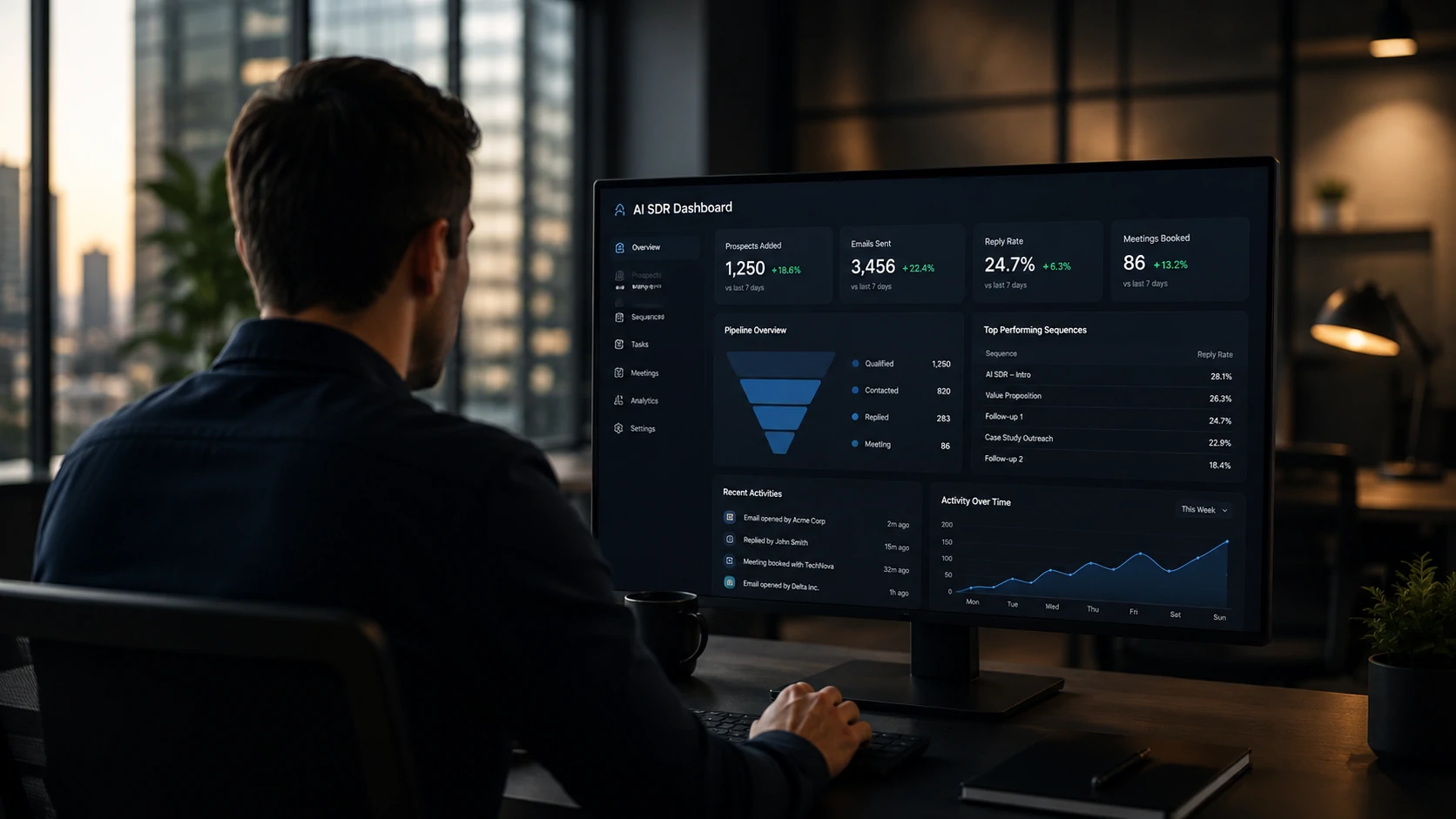
While many businesses are still exploring how to use artificial intelligence in sales, more advanced organizations are already automating nearly every stage of prospecting. AI SDR technology has become one of the most promising applications of AI for B2B lead generation and is expected to play an increasingly important role over the coming years.
What Is an AI SDR?
An AI SDR (Artificial Intelligence Sales Development Representative) is a combination of AI agents, workflow automation and software integrations designed to perform many of the responsibilities traditionally handled by a human Sales Development Representative.
Instead of relying entirely on sales professionals to research companies, qualify prospects and manually send outreach messages, an AI SDR performs these activities using artificial intelligence, structured data sources and automated workflows.
This evolution closely follows the growing adoption of AI Process Automation, as organizations continue looking for ways to eliminate repetitive work while increasing productivity.
How an AI SDR Works
An AI SDR begins by receiving the company’s ideal customer profile and prospecting criteria.
It then identifies companies that match those requirements, finds key decision-makers, analyzes publicly available business information, creates personalized outreach and automatically records every interaction inside the CRM.
Why Businesses Are Adopting AI SDRs
Growing pressure to improve commercial efficiency has pushed organizations to generate more qualified opportunities without increasing the size of their sales teams.
With intelligent AI agents operating around the clock, companies can dramatically reduce the amount of time spent on repetitive prospecting activities.
How an AI-Powered B2B Lead Generation System Works
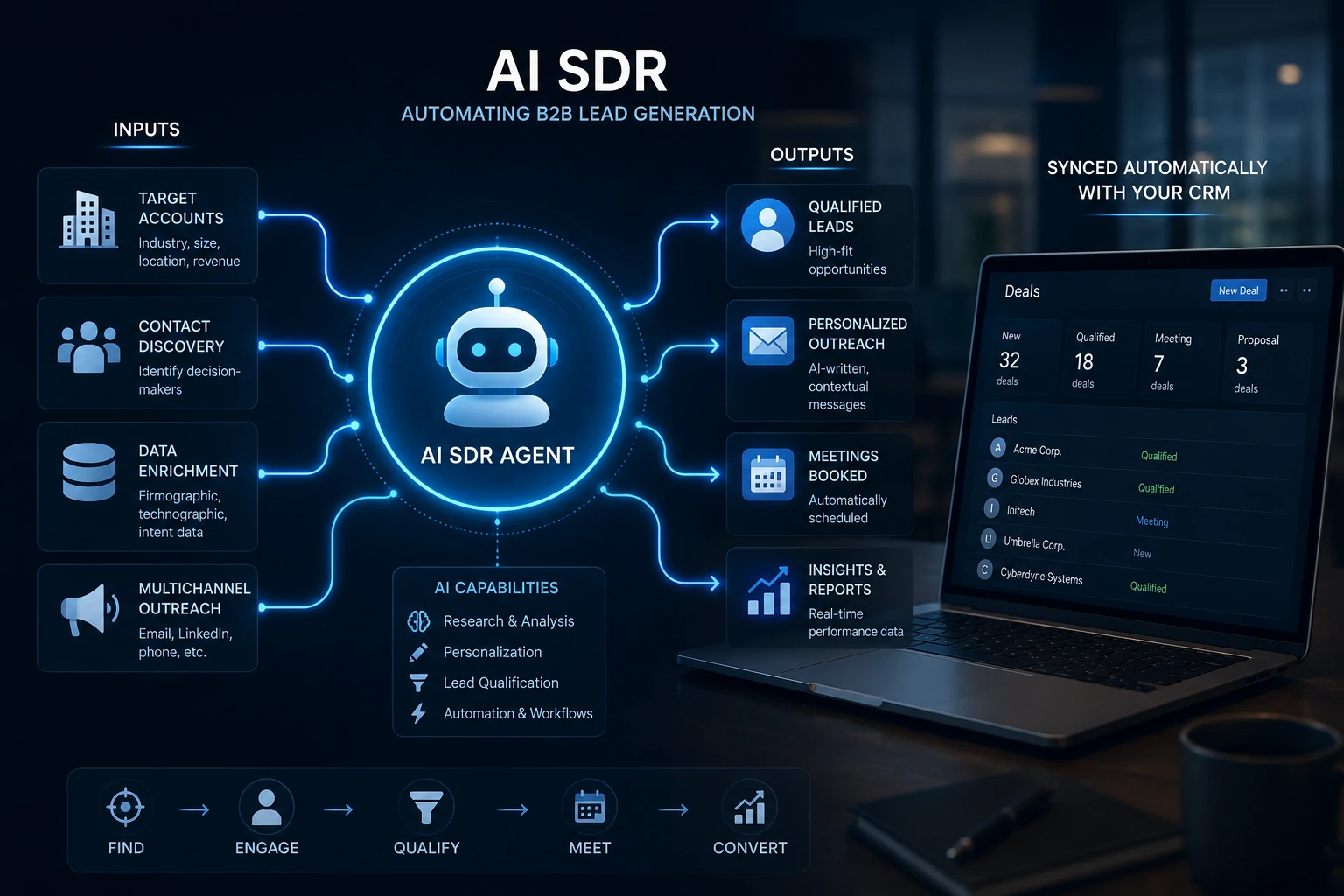
An AI SDR combines artificial intelligence, workflow automation and CRM technology to create a scalable B2B lead generation system.
An AI SDR is far more than a standalone application.
Instead, it operates as an integrated ecosystem connecting Artificial Intelligence, CRM platforms, workflow automation and data enrichment services.
Step 1: Identifying Target Companies
The system searches for organizations that match the company’s ideal customer profile using filters such as industry, company size, geographic location, annual revenue and technology stack.
These criteria significantly improve prospecting accuracy while reducing wasted effort.
Step 2: Enriching Prospect Data
After identifying target companies, specialized data providers locate decision-makers across departments such as sales, technology, operations and marketing.
All relevant information is automatically synchronized with the CRM.
Step 3: Intelligent Lead Qualification
Large language models analyze publicly available information about each company.
They identify buying signals, digital maturity, business challenges and opportunities that can be used to personalize future outreach.
This stage complements AI-powered lead qualification strategies by extending intelligent automation throughout the entire sales development process.
| Feature | Traditional SDR | AI SDR |
|---|---|---|
| Company research | Manual | Automated |
| Initial lead qualification | Manual | AI-powered |
| Personalization | Limited by time | Highly scalable |
| Availability | Business hours | 24/7 |
| Scalability | Depends on team size | Extremely high |
| CRM updates | Manual | Automatic |
Although an AI SDR automates a significant portion of sales development activities, it does not eliminate the need for human sales professionals.
Instead, sales representatives spend less time on repetitive administrative work and more time building relationships, running discovery meetings and closing high-value opportunities.
Tools Required to Build an AI SDR
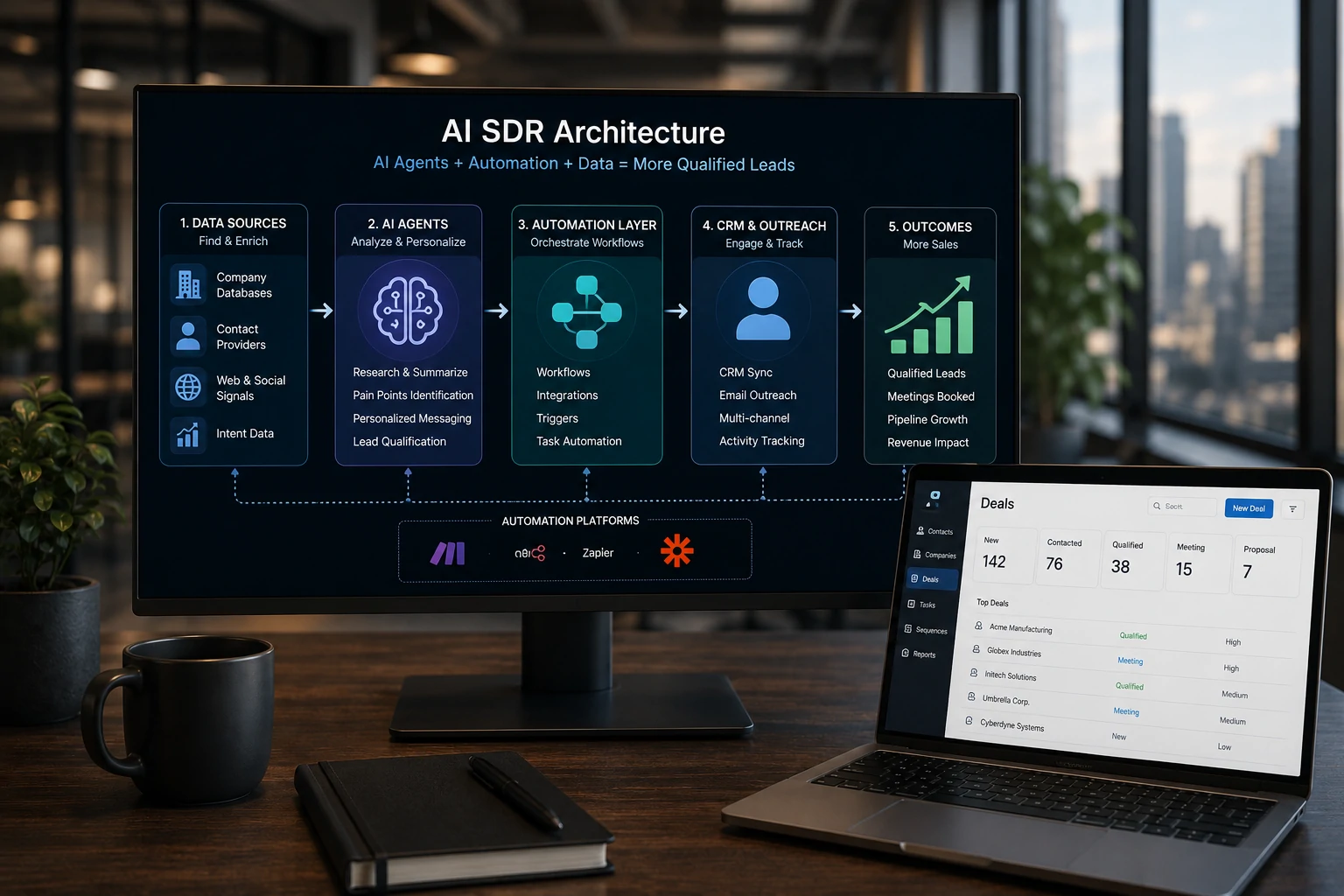
An AI SDR relies on the integration of CRM software, workflow automation, artificial intelligence and data enrichment platforms.
The effectiveness of an AI SDR depends largely on selecting the right technology stack.
CRM Platform
A CRM acts as the central hub for every lead, interaction and sales opportunity.
Popular solutions such as HubSpot, Pipedrive and ActiveCampaign already provide integrations with AI agents and automation platforms.
Workflow Automation
Automation platforms such as Make, n8n and Zapier connect multiple business applications.
These tools allow companies to automatically collect leads, enrich company data, execute AI prompts and synchronize information across their CRM without manual intervention.
Artificial Intelligence
Modern AI models including ChatGPT, Claude and Gemini can analyze company profiles, summarize research, generate personalized outreach messages and assist sales teams in making better decisions.
A Complete AI SDR Workflow
Imagine a software company targeting manufacturing businesses.
An AI SDR identifies organizations that fit the company’s ideal customer profile.
It then locates executives responsible for purchasing decisions.
Next, it analyzes the company’s website, identifies potential business challenges and automatically generates a personalized outreach message.
Every interaction is immediately recorded inside the CRM.
If the prospect responds positively, the AI SDR schedules a meeting or transfers the opportunity to a human sales representative.
This workflow dramatically reduces manual prospecting while creating a more consistent and scalable sales process.
Benefits for Small and Medium-Sized Businesses

Small and medium-sized businesses can leverage AI SDR technology to scale lead generation without dramatically increasing headcount.
For many years, advanced sales automation was only accessible to large enterprises.
Today, affordable SaaS solutions allow small and medium-sized businesses to deploy AI SDR systems with minimal upfront investment.
Higher Productivity
A single sales professional can oversee hundreds of active opportunities simultaneously.
Artificial intelligence handles repetitive operational tasks while the sales team focuses on strategic conversations.
Better Lead Quality
AI analyzes significantly more business information before the first interaction.
As a result, companies spend less time pursuing low-quality prospects and achieve higher conversion rates.
Lower Operating Costs
Automation reduces repetitive administrative work, allowing organizations to scale commercial operations without proportionally increasing staffing costs.
How Much Does an AI SDR Cost?
Implementation costs vary depending on the complexity of the sales operation.
Smaller businesses can start with entry-level CRM subscriptions, automation platforms and AI models.
As lead volume grows, additional integrations and specialized AI agents can be introduced to expand the system.
For most organizations, the investment is offset by increased productivity, shorter prospecting cycles and improved lead quality.
Is an AI SDR Worth It in 2026?
The rapid evolution of AI agents suggests that sales automation will soon become a standard component of modern commercial operations rather than a competitive advantage.
Companies that begin implementing AI SDRs today will have more time to optimize workflows, train teams and establish sustainable competitive advantages.
Rather than replacing sales professionals, AI SDRs enhance the capabilities of commercial teams by continuously transforming business data into qualified sales opportunities.
Organizations already investing in AI-powered CRM, AI Process Automation and intelligent AI agents will be better positioned to compete in an increasingly automated, AI-driven business landscape.
Comentários
Os comentários utilizam autenticação via GitHub para manter um ambiente mais qualificado, seguro e livre de spam.
Entrar ou criar conta no GitHub