
While large corporations compete for space in the artificial intelligence race, small companies have discovered a silent movement that could redefine competitiveness in the coming years: using AI tools to operate with more speed, less cost and greater commercial efficiency. The advancement of accessible platforms is transforming local businesses, e-commerces, agencies and B2B operations into highly automated structures — even without in-house technical teams.
The new generation of AI tools is no longer exclusive to large companies

For years, enterprise automation required complex infrastructure, IT teams and high investments. This quickly changed with the popularization of platforms based on generative AI, no-code automation and intelligent agents.
Today, small businesses can automate:
- customer service;
- content generation;
- commercial funnels;
- internal support;
- data analysis;
- operational management;
- B2B prospecting.
This movement is accelerating primarily because platforms like ChatGPT, Gemini, Notion AI, Zapier, HubSpot, and Make have drastically lowered the technical barrier to automation adoption.
The market already realizes that the dispute is no longer just “who has the most employees” but has become “who operates with the most operational intelligence”.
This new scenario speaks directly to the advancement of the so-called autonomous agent economy, a topic that has already been transforming the global corporate market.
Operating costs begin to fall rapidly
Businesses that previously depended on multiple subscriptions, freelancers and manual processes can now centralize tasks on automated platforms.
In many cases, a small operation achieves:
- produce articles optimized for SEO;
- respond to customers automatically;
- create email campaigns;
- organize CRM;
- generate reports;
- automate sales;
- create capture pages.
All of this using tools accessible via a monthly subscription.
The commercial impact of this change is enormous because small companies start to operate with productivity close to much larger companies.
AI applied to digital marketing has become a real competitive differentiator
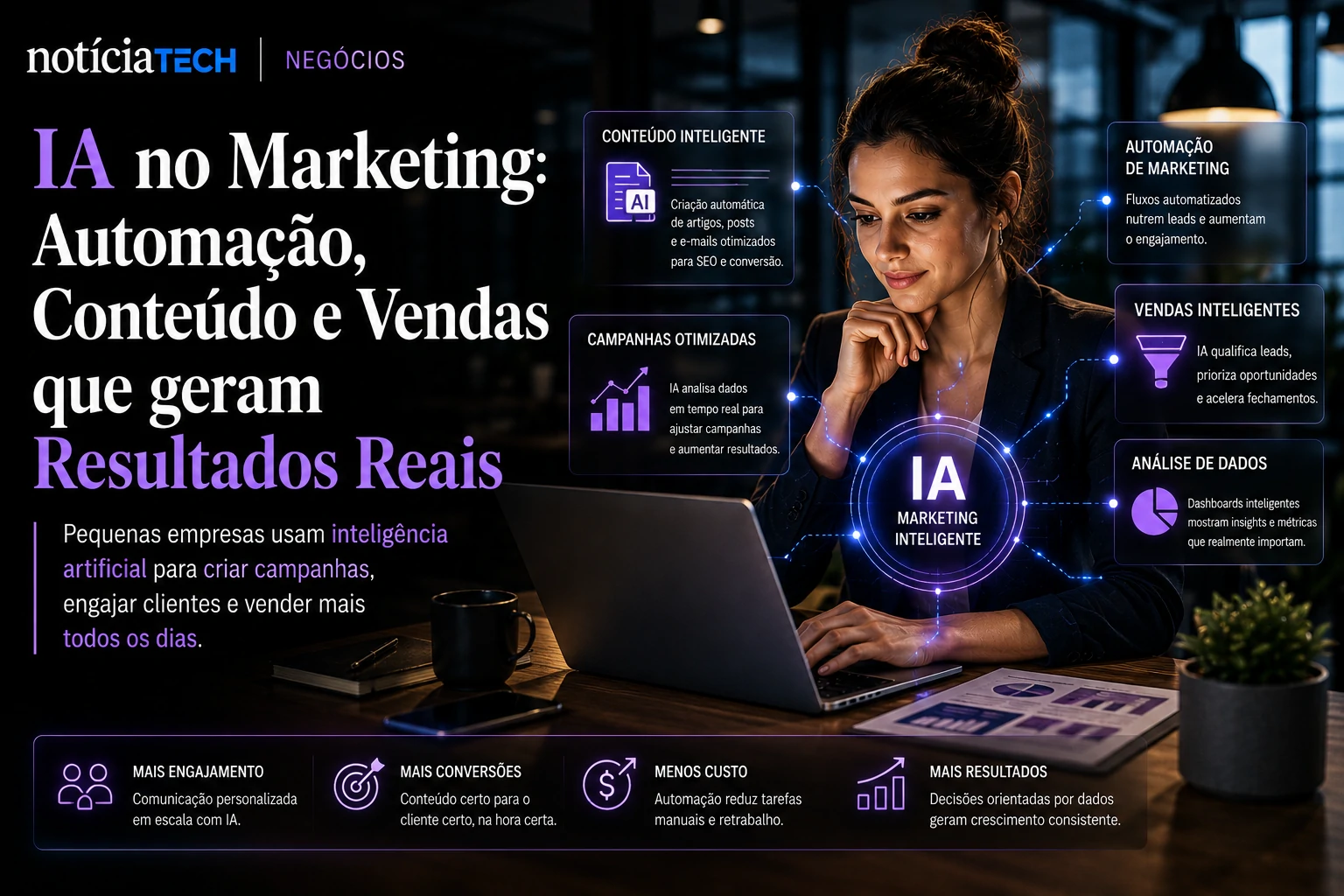
Digital marketing is among the sectors most impacted by artificial intelligence.
Modern tools can analyze user behavior, generate persuasive texts, create ads and optimize campaigns practically in real time.
This movement has created a new dispute known as Search Everywhere Optimization, where brands try to appear not only on Google, but also on AI assistants, conversational searches and social platforms.
Small businesses can compete using intelligent automation
The most important point of this transformation is not just productivity.
It’s reach.
Small businesses can now:
- produce content at scale;
- create consistent digital presence;
- automate relationships;
- increase customer retention;
- reduce operational time;
- strengthen digital branding.
In many markets, smaller companies are growing because they can execute faster than traditional competitors.
Additionally, AI has also started to change the way platforms distribute content and attention.
LinkedIn itself, for example, is transforming into an intelligent distribution ecosystem aimed at businesses, creators and B2B companies.
LinkedIn stops being a CV network and becomes a B2B distribution platform driven by AI
Commercial opportunity for those who enter early
There is an important strategic factor happening right now.
Most small businesses still only use AI for basic tasks.
Those who learn to integrate automation with marketing, content and sales tend to build a competitive advantage that is difficult to recover later.
Companies that adopt AI can now:
- reduce CAC;
- increase productivity;
- create leaner operations;
- improve service;
- expand scale without hiring proportionally.
This creates a relevant commercial opportunity for consultancies, content creators, agencies, freelancers and digital businesses.
The future of small businesses will be increasingly automated

The advancement of artificial intelligence is no longer an experimental trend.
Technology began to become operational infrastructure.
In the coming years, businesses that do not adopt automation will likely face:
- higher operating costs;
- lower execution speed;
- difficulty competing in marketing;
- lower customer retention;
- loss of commercial efficiency.
At the same time, companies that learn to use AI strategically will be able to operate with extremely lean and highly scalable structures.
The transformation has already begun in areas such as:
- automated support;
- conversational sales;
- content generation;
- CRM automation;
- behavior analysis;
- personalization of campaigns;
- corporate intelligent agents.
The market is still in the early stages of this change, which means there is significant space for smaller companies to build an advantage before automation becomes a mandatory standard in the digital environment.
The next big competitive difference may no longer be the size of the company — but rather the level of operational intelligence that it can integrate into the business itself.
Comentários
Os comentários utilizam autenticação via GitHub para manter um ambiente mais qualificado, seguro e livre de spam.
Entrar ou criar conta no GitHub