
The market has entered a new phase: artificial intelligence is no longer a differentiator and has started to become a competitive requirement for companies that want to grow and maintain relevance.
Artificial intelligence is no longer optional
For a long time, artificial intelligence was treated as an innovation of the future.
Something distant.
Something experimental.
Something restricted to large companies.
But that has changed.
Today, AI is already part of the operation of businesses of different sizes.
Marketing.
Sales.
Service.
Data analysis.
Operational automation.
And the impact is direct: more speed, more efficiency and cost reduction.
The problem is that not all companies are following this movement.
And that can be costly.
Companies that adopted AI early are already starting to gain an operational advantage.
Delay in adoption could result in market loss
Every technological transformation creates a new competitive standard.
With AI, this is happening in record time.
Companies that implement artificial intelligence can:
- reduce operational time
- automate repetitive tasks
- improve service
- speed up production
- customize sales
- increase productivity
Meanwhile, companies that postpone investments continue operating in the old model.
The result is predictable.
Higher costs.
Less speed.
Less efficiency.
And less ability to compete.
The new competitive advantage is speed

In the past, competitive advantage came from structure.
Today, speed has become an asset.
Companies that use AI are able to make faster decisions.
Produce more.
Test more.
Climb more.
This completely changes the market dynamics.
Those who take a long time to enter may need to run a lot more later.
And chasing it almost always costs more.
AI is already changing marketing, sales and operations
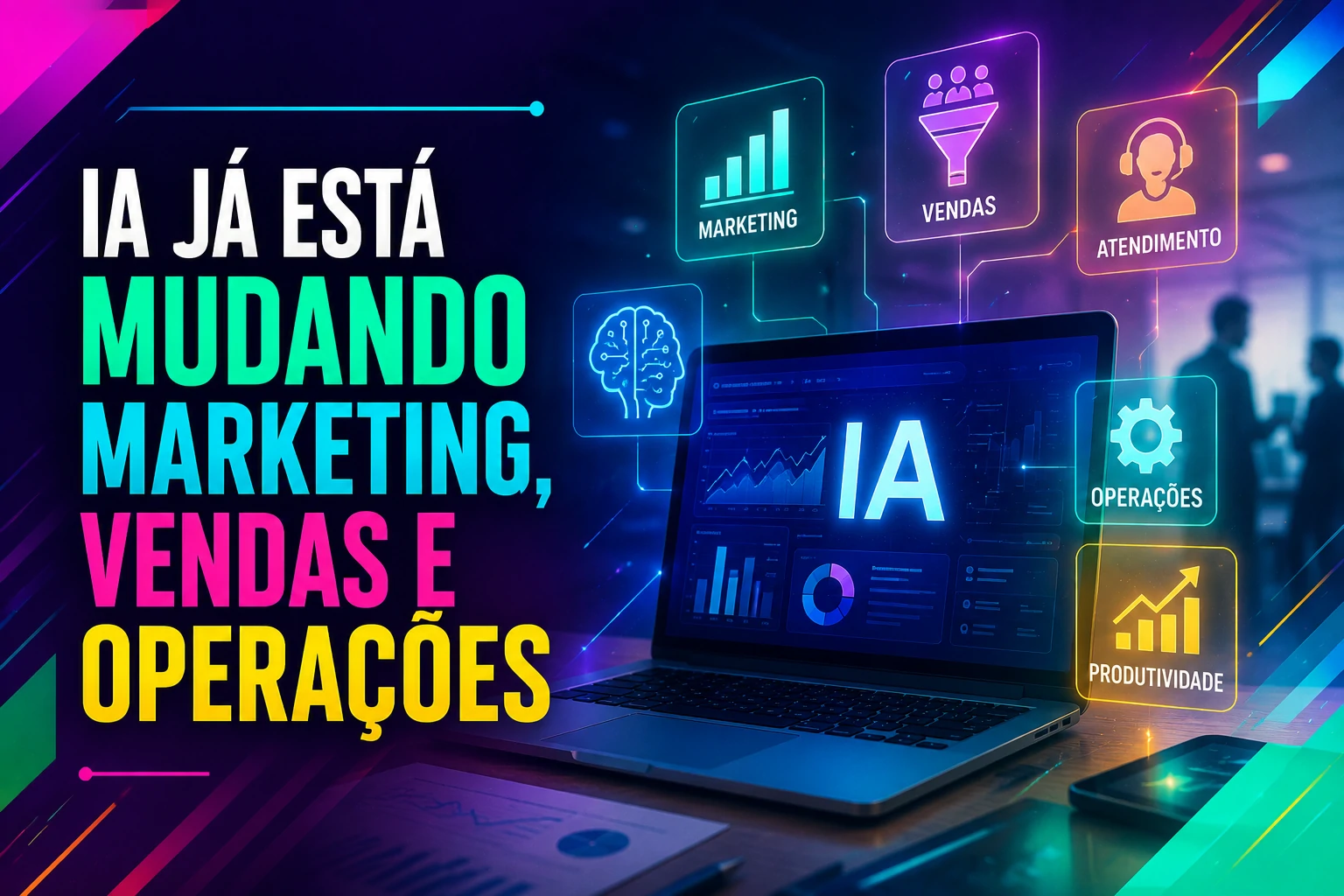
Artificial intelligence doesn’t just impact technology.
It is already changing core areas of the business.
Marketing
Creation of campaigns.
Segmentation.
Funnel automation.
Content production.
Sales
Lead qualification.
Commercial personalization.
Behavior analysis.
Operations
Process automation.
Error reduction.
Productivity improvement.
Commercial and operational sectors already use AI as a scaling tool.
Small businesses also need to act
There is a common mistake in the market.
Thinking that AI is for big companies.
Today that no longer makes sense.
Affordable tools allow small businesses to also automate processes and increase efficiency.
Those who start early learn faster.
And whoever learns faster builds an advantage.
Even if the initial investment is small, the operational gain can be large.
The risk is not investing in AI. It’s not investing.
Every change creates insecurity.
But the biggest current risk is not implementing artificial intelligence.
It’s ignoring the movement.
While one company hesitates, another moves forward.
While one company analyzes, another automates.
While one company waits, another scales.
This is the new competitive landscape.
AI is redefining productivity.
And productivity redefines the market.
The market entered a new competitive race

Artificial intelligence is no longer a promise.
It has already become an operational reality.
And now it has become a strategic dispute.
In the coming months, companies that accelerate investments in AI are likely to gain more space, operate more efficiently and grow faster.
Those who delay may discover too late that the market has already changed.
Companies that integrate AI faster tend to lead the next phase of the market.
Comentários
Os comentários utilizam autenticação via GitHub para manter um ambiente mais qualificado, seguro e livre de spam.
Entrar ou criar conta no GitHub