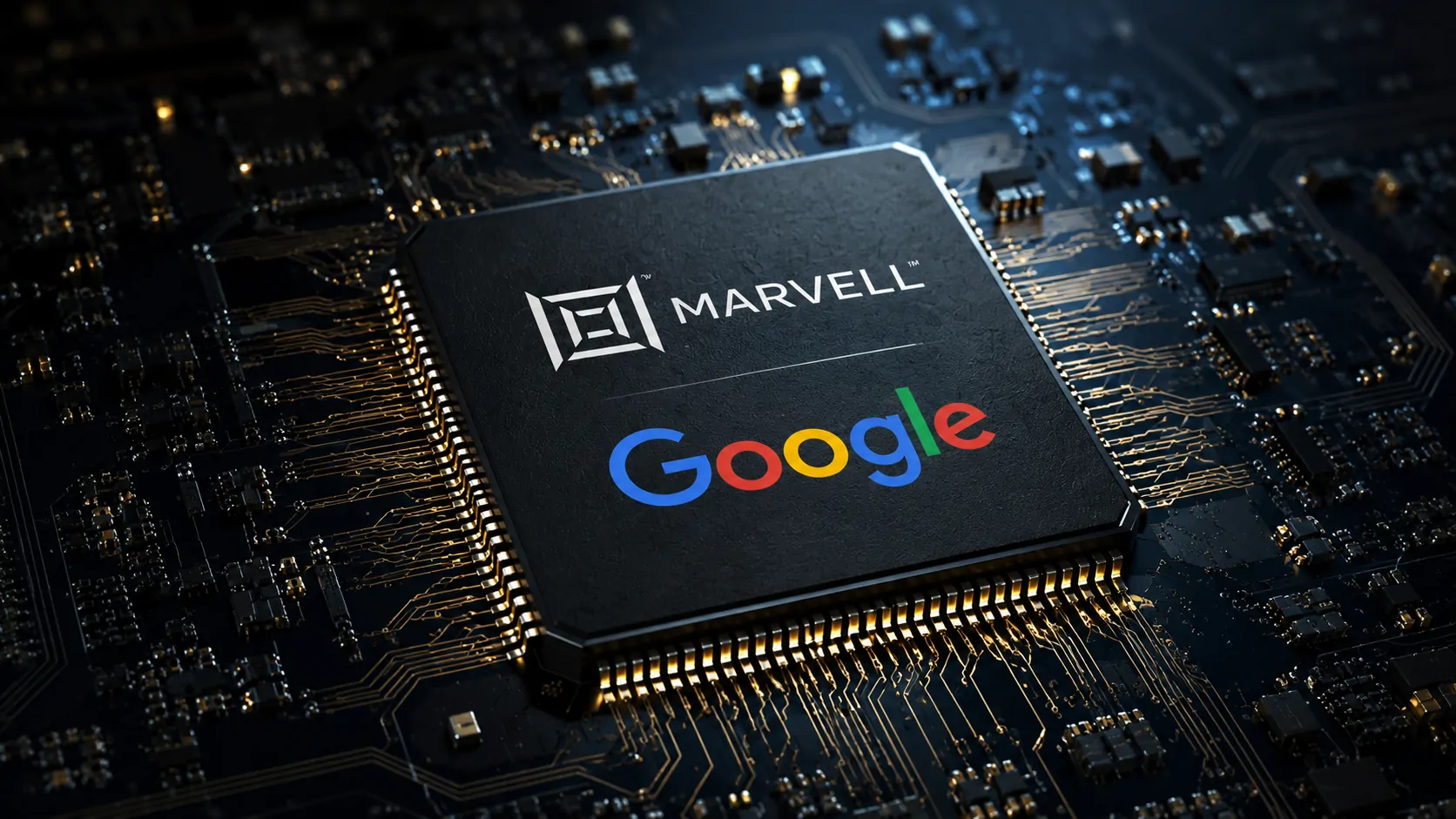
The artificial intelligence race is creating a competition that goes far beyond models such as Gemini, ChatGPT and Claude. As companies increase their AI investments, they also have to decide who will provide the infrastructure needed to process that demand. Google’s new agreement with Marvell shows how this competition is reaching the core of the chip supply chain.
Google expands its strategy to control AI infrastructure
A deal that goes beyond a supplier relationship
Google has reached an agreement with Marvell Technology to expand the development of custom chips for artificial intelligence infrastructure. The partnership puts a semiconductor specialist at the center of Google’s strategy to expand its computing capacity.
The deal could generate up to $120 billion in revenue for Marvell through fiscal 2033, provided that the specified targets are met. The figure therefore represents long-term potential rather than an immediate payment.
The agreement also shows that Google’s AI strategy is becoming increasingly tied to its ability to control critical components of the infrastructure that powers its services.
Why Google wants custom chips
Demand for AI computing has grown rapidly, turning infrastructure into one of the industry’s largest costs. Rather than relying exclusively on components designed for a wide range of applications, major technology companies are increasingly seeking solutions tailored to their own requirements.
Google already develops its TPU family of accelerators, which are designed for artificial intelligence workloads. The partnership with Marvell expands this ecosystem and involves technologies related to data processing, storage and connectivity.
The strategy also helps explain why infrastructure has become a business issue. The greater the use of AI, the more important it becomes to control computing performance, availability and operating costs.
Who is Marvell and why has it become important?
Marvell develops semiconductor and silicon solutions used in digital infrastructure and artificial intelligence systems.
A company that works behind the scenes
Marvell Technology does not have the same visibility among consumers as companies such as Nvidia, Google or AMD. Its business, however, is directly connected to the infrastructure that allows large volumes of data to be processed and moved.
The company develops semiconductor solutions for processing, storage, connectivity and networking. It also works on custom silicon, allowing major customers to develop components tailored to specific requirements.
This position helps explain why the company can benefit from the growth of AI without selling a consumer product that is widely known to the public.
The role of custom silicon
Custom chips allow a company to adapt hardware to the characteristics of its own systems. In AI, this can be particularly relevant because different applications require specific combinations of processing, memory and data communication.
For Google, this flexibility can complement its TPUs and other components used in data centers. For Marvell, contracts of this kind represent an opportunity to participate directly in the expansion of infrastructure operated by major technology companies.
The deal therefore turns a company that is relatively unknown to consumers into an important part of the economy being built around AI.
What does the $120 billion figure actually mean?
It is not a $120 billion payment
The $120 billion figure needs to be interpreted carefully. It represents an estimate of revenue that Marvell could generate over the life of the agreement, rather than an amount Google is paying today.
The transaction also gives Google the option to acquire up to approximately $12.2 billion worth of Marvell shares through a warrant. If fully exercised, the transaction would make Google one of Marvell’s largest shareholders.
That creates a deeper economic relationship between the two companies. Google would have an even greater interest in the growth of a strategic infrastructure supplier.
The market reacted to the announcement
The financial scale of the deal immediately attracted investor attention. Marvell shares rose following the announcement, while shares of Broadcom, which had been one of Google’s major partners for custom chips, declined.
The market reaction shows that investors do not view the agreement simply as a commercial contract. It also represents a potential shift in how opportunities are distributed across the AI infrastructure supply chain.
For the industry, the message is significant: the growth of artificial intelligence is creating room for multiple specialized suppliers, not only the best-known GPU manufacturers.
The chip race is reshaping the AI market
The growth of AI services is increasing the importance of custom chips for data processing, storage and connectivity.
Nvidia remains dominant, but the market is diversifying
Nvidia remains one of the most important companies in AI infrastructure, particularly because of its position in the GPU market and the software ecosystem surrounding its accelerators.
The rise of custom chips, however, creates a second competitive front. Companies such as Google, Amazon and other major technology firms are developing components designed to handle specific workloads.
This trend is also visible in the strategy of other AI companies. Anthropic, for example, has already moved toward its own custom chip strategy for Claude, showing how major model developers are seeking greater control over the infrastructure behind their systems.
That does not necessarily mean replacing GPUs. In practice, large data centers can combine different architectures depending on the type of processing required.
Cost has become a strategic issue
The expansion of AI has turned computing costs into a matter directly connected to business strategy. Every improvement in efficiency can make a significant difference when thousands of servers are running continuously.
That is why custom chips have become increasingly important. They allow major companies to optimize the relationship between performance, power consumption and operating costs.
The transformation also helps explain why AI infrastructure is becoming one of the technology industry’s major investment areas.
The impact on companies using artificial intelligence
Infrastructure can affect the price of AI
The move between Google and Marvell may seem far removed from a company that simply uses AI tools. But decisions like this can influence the economics of cloud services.
When providers increase the efficiency of their data centers, they gain more room to offer AI computing at different price points. This can affect companies that rely on APIs, cloud platforms and applications built on generative AI.
Infrastructure therefore stops being an exclusively technical concern and becomes a factor that can directly influence corporate financial planning.
The AI supply chain is becoming more specialized
The agreement also reinforces a broader trend: the AI economy is creating an increasingly specialized supply chain made up of accelerator manufacturers, semiconductor companies, cloud providers, data center operators and model developers.
This transformation is also changing the technological structure of enterprises. Companies that want to understand how different AI components fit into corporate systems can explore the guide to enterprise AI architecture, RAG, MCP, AI agents, automation and copilots.
This shift helps explain why the economic value of AI is not concentrated only in companies that create the models. Significant opportunities exist across every layer required to put these systems into production.
For managers and entrepreneurs, following this supply chain is becoming increasingly important because infrastructure changes can affect costs, availability and the ability to scale AI services.
Google and Marvell show where the AI economy is heading

Google and Marvell are part of an increasingly integrated chain of companies supporting the expansion of artificial intelligence.
Hardware has become part of corporate strategy
The partnership shows that competition in artificial intelligence is not limited to model quality. Control over hardware, networking, storage and computing capacity can also determine how quickly a company can expand its services.
The move follows a broader trend among Big Tech companies: investing directly in infrastructure to reduce bottlenecks and gain greater control over AI costs.
Google’s partnership with Marvell also fits into a wider shift among AI companies toward custom silicon. Anthropic’s move to develop custom AI chips for Claude is another example of how major AI companies are seeking greater control over the infrastructure behind their products.
For Google, the agreement expands the alternatives available for its infrastructure. For Marvell, it creates a potentially enormous opportunity in one of technology’s fastest-growing markets.
A shift that could last for years
The most important part of the agreement is not just the $120 billion figure. It is the long-term horizon created by the partnership.
If demand for AI continues to grow, companies specializing in infrastructure components could capture an increasingly large share of the value generated by the sector. This means the next phase of technological competition will also be fought behind the scenes.
The partnership between Google and Marvell is an example of how artificial intelligence is reshaping relationships among major technology companies, suppliers and investors. For anyone following the market, the signal is important: the AI economy is being built not only by the models users see on their screens, but also by the chips working far behind them.
Comentários
Os comentários utilizam autenticação via GitHub para manter um ambiente mais qualificado, seguro e livre de spam.
Entrar ou criar conta no GitHub