
For years, companies have invested millions in marketing teams, media buyers, designers, and agencies to plan, execute, and optimize digital campaigns. Now, Meta wants to simplify that process using artificial intelligence. The strategy led by Mark Zuckerberg aims to allow advertisers to provide only their objectives and budget while intelligent systems take over tasks that previously required entire teams. The move could represent one of the biggest transformations in the advertising industry since the rise of social media.
Meta Wants to Turn Advertising Into a Fully Automated Process
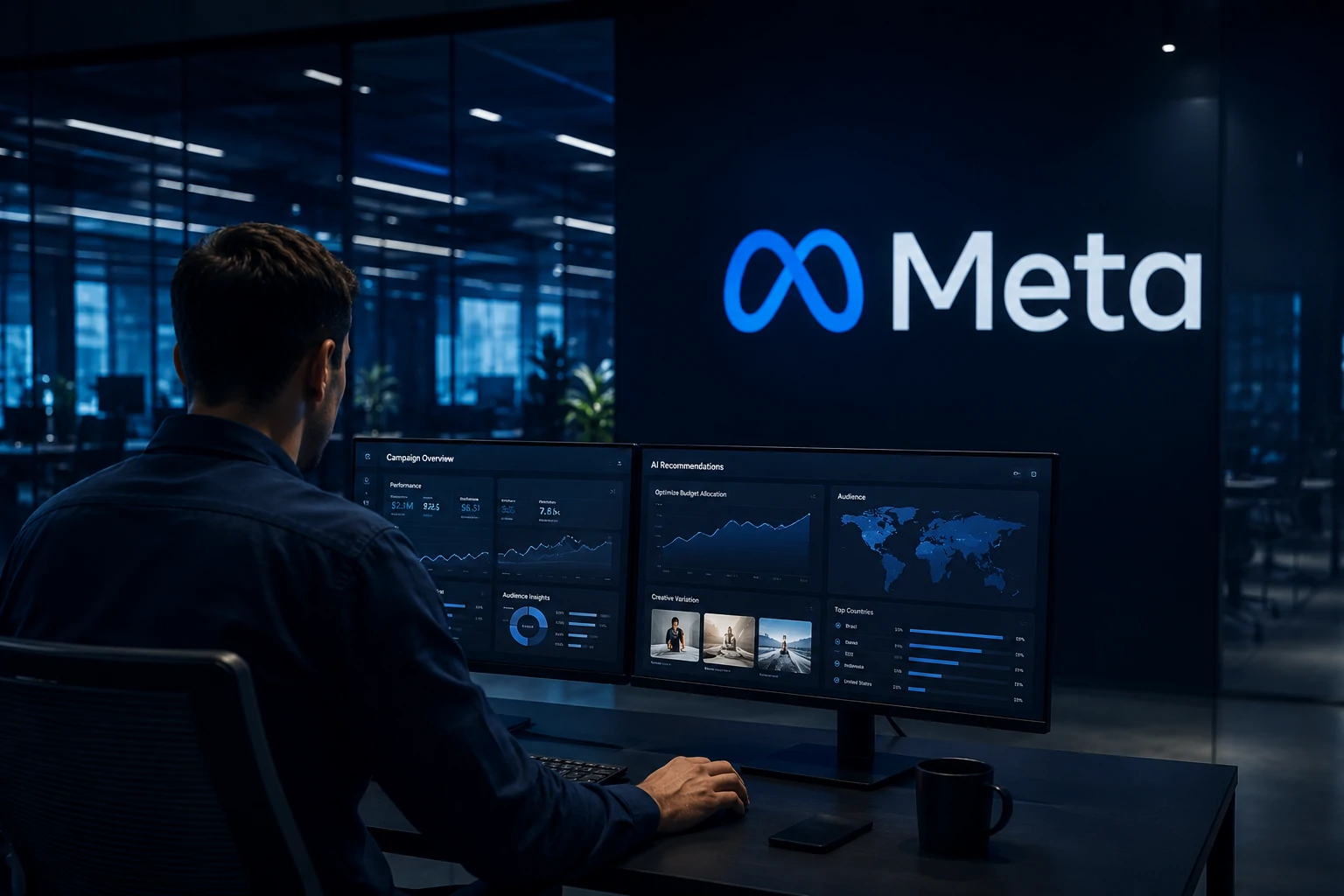
AI tools are beginning to perform activities that traditionally required specialized teams.
Meta’s strategy is to reduce the complexity of digital advertising and increase the number of businesses capable of advertising across its platforms.
In practice, the company is working toward campaigns that require less and less human intervention. Advertisers provide business goals, target audiences, and available budgets, while artificial intelligence handles ad creation, distribution, and optimization.
The objective is to make advertising simpler, more accessible, and more scalable.
Caption: Advertising automation is advancing rapidly across Meta’s ecosystem.
What changes for advertisers?
Companies become less dependent on technical expertise to execute campaigns.
Activities such as audience targeting, creative testing, budget allocation, and performance optimization can be performed automatically.
Why is Meta doing this?
The easier advertising becomes, the more businesses are likely to invest in it.
The strategy also strengthens advertisers’ dependence on Meta’s ecosystem.
The Traditional Agency Model Is Beginning to Face New Pressure

Operational services lose value as artificial intelligence takes over repetitive tasks.
The rise of automation does not necessarily mean the end of agencies.
However, it places pressure on a significant portion of the industry that built its revenue around highly repetitive operational activities.
Campaign setup, ad testing, audience adjustments, and basic optimization may cease to be meaningful competitive advantages.
What can artificial intelligence replace?
Among the activities that can be automated are:
- Initial campaign creation.
- Production of creative variations.
- Audience segmentation.
- A/B testing.
- Budget optimization.
- Basic performance analysis.
What still requires human intelligence?
Brand strategy.
Competitive positioning.
Corporate storytelling.
Community building.
Growth planning.
These activities depend on market interpretation, cultural context, and long-term vision.
This transformation mirrors recent changes seen on professional platforms, as discussed in LinkedIn Stops Being a Resume Network and Becomes an AI-Powered B2B Distribution Platform.
Strategic value is beginning to outweigh operational value in digital marketing.
Advertising Has Officially Entered the Era of Intelligent Agents
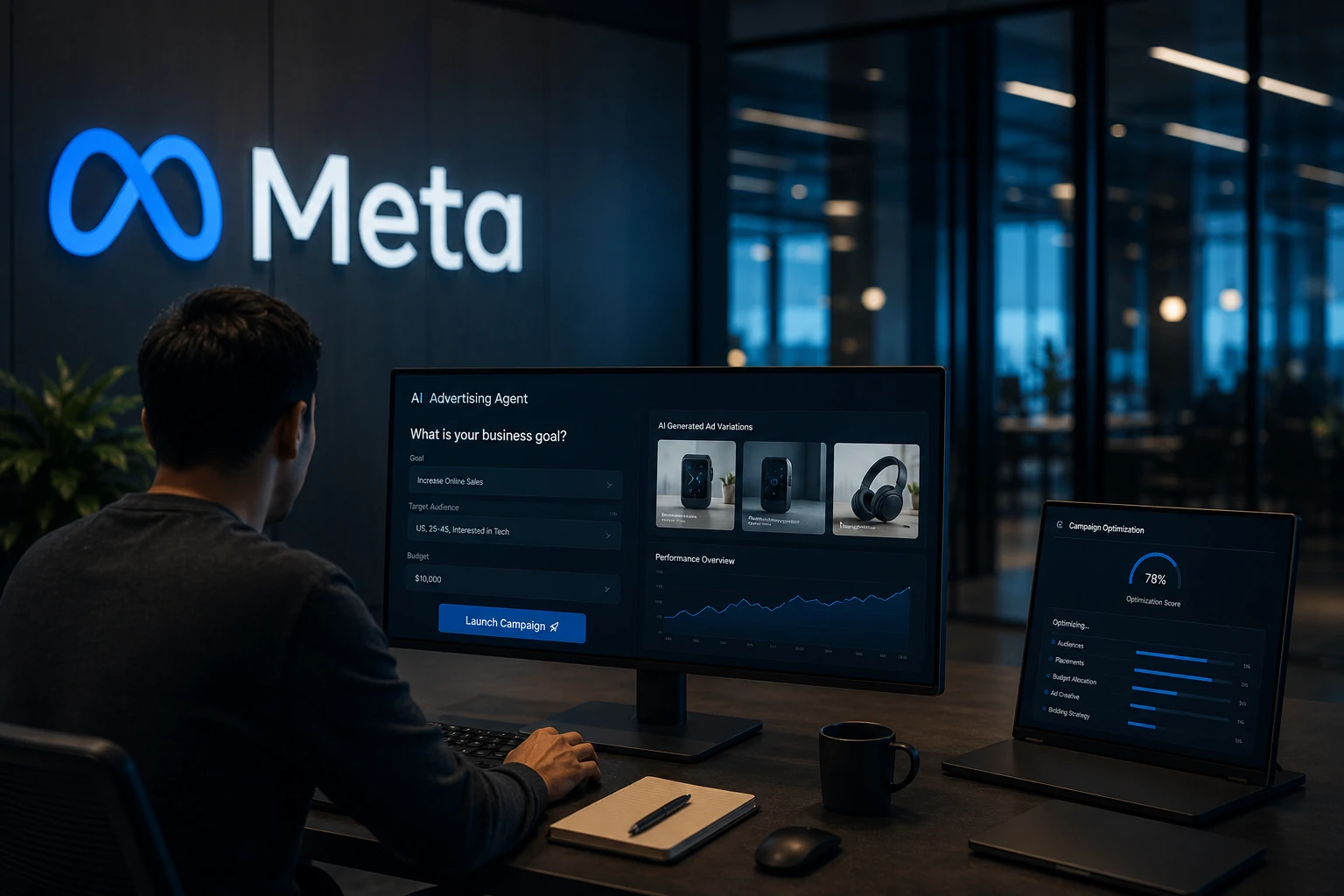
Platforms are starting to operate as autonomous systems focused on business outcomes.
Meta’s move is part of a broader trend emerging across the technology industry.
Companies are no longer offering only tools. They are increasingly offering systems capable of executing complete workflows.
In this environment, advertising stops being an operational activity managed by humans and becomes a goal-oriented process.
What does agentic advertising mean?
Agentic advertising is a model in which intelligent systems receive specific goals and execute the actions required to achieve results.
The focus shifts away from execution and toward business outcomes.
Why is this important?
Companies do not buy campaigns.
Companies buy growth.
By automating much of the execution process, platforms such as Meta bring their products closer to the actual business results advertisers are seeking.
This same logic is already appearing in other areas of the digital economy, as discussed in OpenAI and Salesforce Accelerate the Agentic SaaS Era and Push Companies to Rethink Enterprise Software.
Caption: Intelligent systems are beginning to operate entire processes without constant human intervention.
Small Businesses May Be the Biggest Beneficiaries
Meta’s transformation strategy is likely to benefit companies with limited marketing resources the most.
Smaller businesses gain access to capabilities that were previously available only to organizations with specialized teams.
Technical barriers decrease.
Execution speed increases.
Operational costs decline.
What changes for small businesses?
Small businesses will be able to:
- Launch campaigns more quickly.
- Reduce dependence on specialists.
- Run tests at scale.
- Improve investment efficiency.
- Increase competitiveness.
A new competitive advantage emerges
As execution becomes automated, differentiation depends less on operational expertise and more on the ability to build a brand, reputation, and customer relationships.
Organizations that develop strong positioning will continue to maintain advantages that are difficult for algorithms to replicate.
The Real Battle Is Not About Advertising, but About Data
The rise of artificial intelligence in advertising reveals an even deeper transformation.
Intelligent systems depend on massive amounts of data to learn, optimize campaigns, and improve results over time.
The more advertisers use automated tools, the more information flows back into the platform’s models.
This strengthens a continuous learning cycle that expands Meta’s competitive advantage.
At the same time, it reinforces the company’s role as an intermediary between brands and consumers.
Why have data become so important?
Algorithms rely on information to identify patterns, predict behavior, and improve campaign performance.
The larger the available data pool, the more accurate recommendations and optimizations tend to become.
What does this mean for the market?
Competition between platforms is no longer focused solely on capturing user attention.
It is increasingly about controlling the data that power artificial intelligence systems.
Over the coming years, the most important discussion for agencies and marketing professionals may not be how to compete with artificial intelligence. The central question will be identifying which activities continue to require creativity, strategic thinking, and human understanding in an increasingly automated marketplace.
Comentários
Os comentários utilizam autenticação via GitHub para manter um ambiente mais qualificado, seguro e livre de spam.
Entrar ou criar conta no GitHub