
Robin Vince, CEO of BNY, is defending a view of artificial intelligence that goes beyond simply reducing costs. For him, one of the most important gains may be the capacity technology frees up for people and companies to do more, develop new products and increase the value delivered to customers.
Who Is Robin Vince and Which Bank Does He Lead
From Goldman Sachs to BNY
Robin Vince is chairman and CEO of BNY, one of the largest financial institutions in the United States. He became the bank’s chief executive in 2022 after building a long career at Goldman Sachs, where he held leadership positions across risk management, operations, treasury and international businesses.
His background helps explain why his assessment of artificial intelligence is attracting attention. Vince is not speaking about AI simply as a market observer, but as the executive responsible for an institution operating at enormous financial scale.
In 2025, Vince also became chairman of the BNY board, expanding his influence over the company’s long-term strategy.
Why BNY Matters to the AI Discussion
BNY is not a traditional consumer bank focused primarily on retail customers. The company operates across financial services and critical market infrastructure, managing, moving and safeguarding assets for clients around the world.
That business model puts AI in the middle of concrete challenges involving scale, data, security, productivity and decision-making.
Vince’s relevance to the AI industry increased further in July 2026, when he was appointed to the boards of the OpenAI Foundation and OpenAI Group PBC, bringing his financial-sector experience closer to the strategy of one of the most important companies in the current AI race.
Vince’s View: AI Should Create Capacity
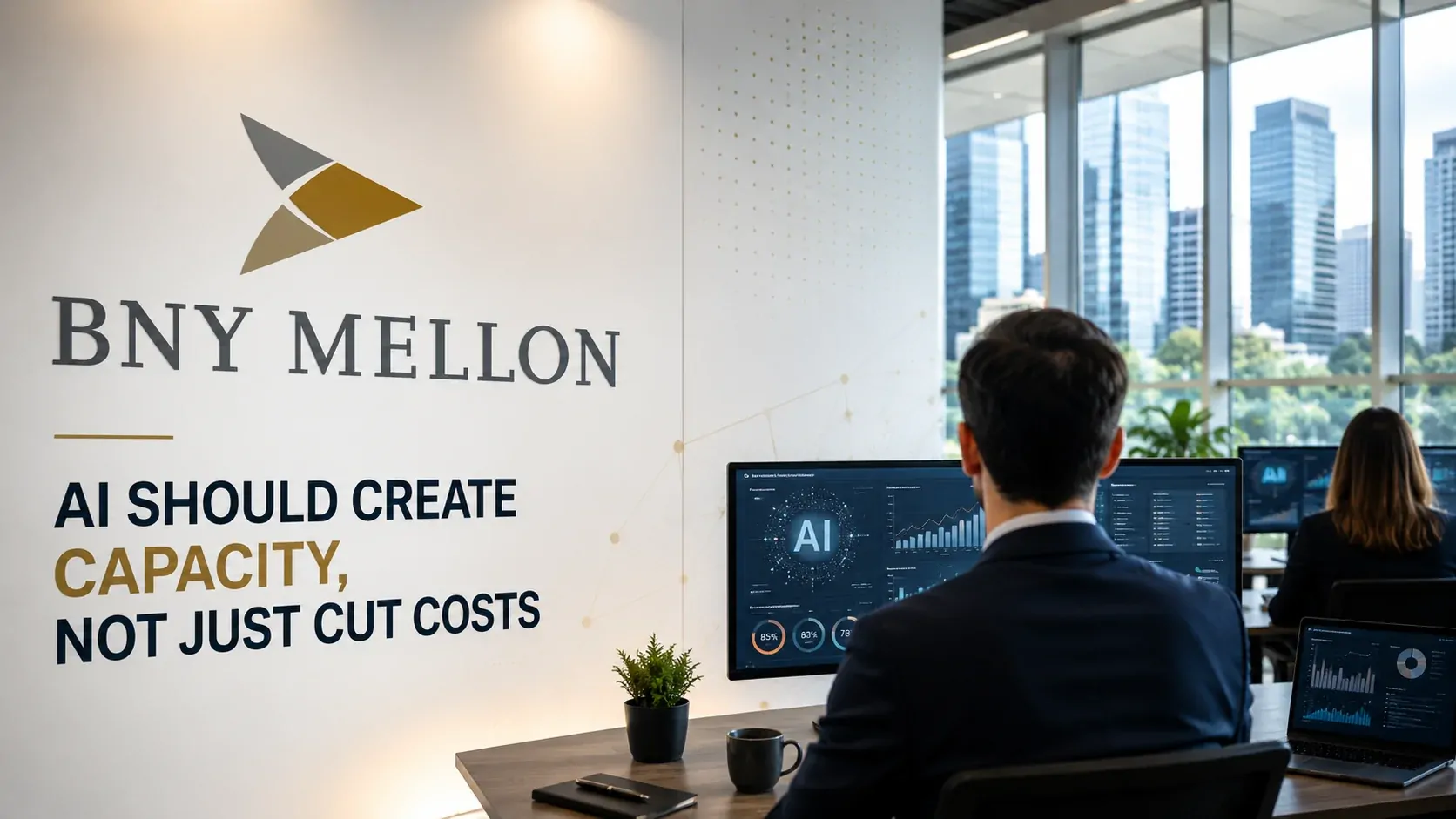
For Robin Vince, the value of AI does not end with efficiency: technology can free capacity for higher-value activities.
What Does Creating Capacity Mean?
The distinction may appear small, but it changes how a company can measure the return on its AI investments.
When a tool automates a task, the immediate result is usually time savings. The traditional interpretation ends there: fewer hours mean lower costs.
Robin Vince’s view adds a second step. If a company saves time on a specific activity, it can use that freed capacity to serve more customers, develop products, improve processes or allow employees to focus on more complex decisions.
Under this model, efficiency becomes more than a cost-reduction metric. It becomes a resource that can be reinvested.
The Limit of Thinking Only About Cost Cuts
A strategy focused exclusively on reducing expenses can view AI primarily as a replacement for tasks. A capacity-building strategy instead asks what an organization can accomplish after those tasks become faster or partially automated.
That distinction matters because the economic impact of AI does not depend only on how many activities a company can automate.
It also depends on where the freed capacity is deployed.
That is where the BNY CEO’s view becomes particularly relevant for business leaders. AI investment becomes more meaningful when it is connected to a concrete change in how the business operates, rather than adopted simply because the technology has become a market priority.
How BNY Is Turning AI Into Business Infrastructure
From Experimentation to Integration
The BNY strategy shows that Vince’s view is not limited to a statement about productivity.
The institution has been developing its own corporate AI platform, Eliza, designed to integrate different models and artificial intelligence applications across the organization. The bank is also working with multi-agent systems and solutions designed to work alongside employees.
This approach represents an important shift. Instead of distributing isolated AI tools to employees, the company is working to incorporate AI into its underlying processes.
The goal is to turn the technology into a permanent layer of the operating model.
Where Capacity Creation Appears
BNY says its AI strategy is designed to improve efficiency, innovation and the quality of services delivered to clients while creating capacity for employees to spend more time on higher-value work.
The same logic is visible in the institution’s strategic planning for 2026.
The company aims to move from broad AI availability toward deeper integration between data, platforms, processes and products. That matters because the real scale benefit is more likely to appear when AI stops being a separate tool and becomes part of the operational workflow.
This helps explain why the corporate AI discussion is moving from tool adoption toward process transformation.
What Changes for Companies Adopting AI

When repetitive tasks become faster, the challenge becomes deciding where to apply the capacity created by AI.
Productivity Is Not the Same as Transformation
A company can implement an AI assistant and gain productivity without changing its underlying business model.
That happens when technology simply accelerates an existing task.
Transformation begins somewhere else: when an organization uses that additional capacity to change processes, develop products, serve customers differently or make decisions with greater speed and quality.
That makes the BNY experience a useful reference. The bank is attempting to connect AI to a broader corporate architecture involving data, security, governance, applications and people.
Freed Capacity Requires a Strategy
There is an important condition in this equation: creating capacity does not automatically produce growth.
If a company automates an activity but has no strategy for using the time, resources or data that have been freed, part of AI’s economic potential can remain unrealized.
That is why Vince’s argument places an additional responsibility on business leaders.
The question is no longer only “how much can AI save?” It also becomes “what can the company do with what AI has made possible?”
This shift is also connected to the broader discussion about how artificial intelligence is changing the way companies are valued. The Notícia Tech has explored this transformation in How AI Is Changing the Value of Technology Companies, examining how technology can change the way the market evaluates businesses.
Why BNY’s Strategy Matters to the Market
AI Moves Onto the Growth Agenda
The BNY experience points to an important trend in corporate AI adoption: investments are increasingly being treated as part of a growth strategy rather than simply as technology projects.
When AI becomes embedded in products and processes, returns can appear in different parts of the organization.
They can come from reducing manual work, accelerating analysis, improving decisions or enabling companies to serve customers with structures that previously required more resources.
For large organizations, this combination can matter more than simply reducing the cost of an individual task.
The Challenge Becomes Scaling Safely
The financial sector also highlights another problem: the deeper AI becomes integrated into operations, the greater the need for governance.
Sensitive data, financial decisions, internal controls and regulatory requirements make it insufficient to simply give employees access to AI models.
BNY has been treating security, governance and integration as interconnected parts of its strategy. That suggests that creating capacity also requires mechanisms to control how that capacity is used.
This becomes particularly relevant as AI agents gain greater autonomy inside companies. The Notícia Tech has examined this challenge in AI Agents and the New Problem They Create for Companies, showing how autonomous systems create new questions about responsibility when AI begins acting directly on corporate processes.
The Next Competition Will Be About Capacity, Not Just Efficiency

The next stage of enterprise AI may be defined less by the number of tasks automated and more by the additional capacity organizations can turn into growth.
What Robin Vince Is Signaling
Robin Vince’s comments matter because they summarize a shift in how large companies may interpret the return on AI.
During the first phase of corporate AI adoption, the dominant question was how much work could be automated. Now a more strategic question is emerging: how much higher-value work can an organization perform when AI takes over part of its operational workload?
That does not mean cost reduction has become irrelevant.
It means cost reduction may be only one stage of the process.
What to Watch in the Coming Months
The evolution of this strategy will depend on companies’ ability to turn productivity gains into new economic results.
It will be important to watch whether freed capacity is actually converted into new products, commercial expansion, better customer service, innovation and higher-value work.
It will also be important to see whether other major institutions begin using similar language when discussing their AI investments.
If that happens, the change will go beyond corporate vocabulary. The way companies calculate the return on artificial intelligence could begin shifting from “how much can we save?” toward “how much more can we do?”
That second question is what makes Robin Vince’s view particularly relevant to the next phase of AI in business.
Comentários
Os comentários utilizam autenticação via GitHub para manter um ambiente mais qualificado, seguro e livre de spam.
Entrar ou criar conta no GitHub