
Over the past few years, artificial intelligence has evolved from a corporate experiment into a strategic priority. Rather than simply adding AI tools to existing processes, leading organizations have started reorganizing their operations around this technology. This shift gave rise to the concept of AI First, an approach that could redefine productivity, innovation, and competitiveness throughout the next decade.
What Is AI First?
AI First is a business strategy that places Artificial Intelligence at the center of decision-making, internal processes, and product development.
In a traditional organization, AI is often treated as a complementary tool. In an AI First company, however, the starting question changes from “How do we execute this process?” to “How can AI execute, accelerate, or improve this process?”
This approach represents a structural shift similar to the digital transformation wave of the past decade, but with potentially deeper implications for operations, knowledge work, and productivity.

AI First means designing processes around artificial intelligence before defining operational execution.
How Did the AI First Concept Emerge?
The term gained momentum after executives at Google advocated transitioning the company from a “mobile-first” organization to an “AI First” organization.
The idea was straightforward: artificial intelligence would no longer be an isolated feature but instead become the foundational layer behind nearly every digital product.
Why Has the Concept Become Relevant?
Advancements in generative AI models have dramatically expanded the possibilities of intellectual automation.
Today, activities involving analysis, content creation, software development, research, customer support, and decision-making assistance can be partially performed by AI systems.
How Does an AI First Strategy Work?
An AI First strategy works by redesigning processes so that artificial intelligence becomes involved from the very beginning of operations.
Rather than automating isolated tasks, organizations rethink entire workflows.
The goal is to improve speed, scalability, and operational efficiency.

AI First organizations redesign workflows to integrate AI from the earliest stages of business processes.
The Role of Data
Data becomes an even more critical strategic asset.
Without structured, governed, and accessible information, AI systems deliver limited results.
For that reason, many organizations invest simultaneously in data governance, modern architecture, and system integration.
The Role of AI Agents
The rise of AI Agents has accelerated adoption of the AI First model.
Tools capable of executing complex tasks expand the operational capacity of teams.
To better understand this evolution, explore the article How MCP Works: A Complete Guide to AI Agents.
What Are the Benefits of the AI First Model?
AI First organizations aim to transform artificial intelligence into a lasting competitive advantage.
The benefits typically appear in productivity, execution speed, and decision quality.
Additionally, the strategy creates opportunities to scale operations without proportional increases in costs.
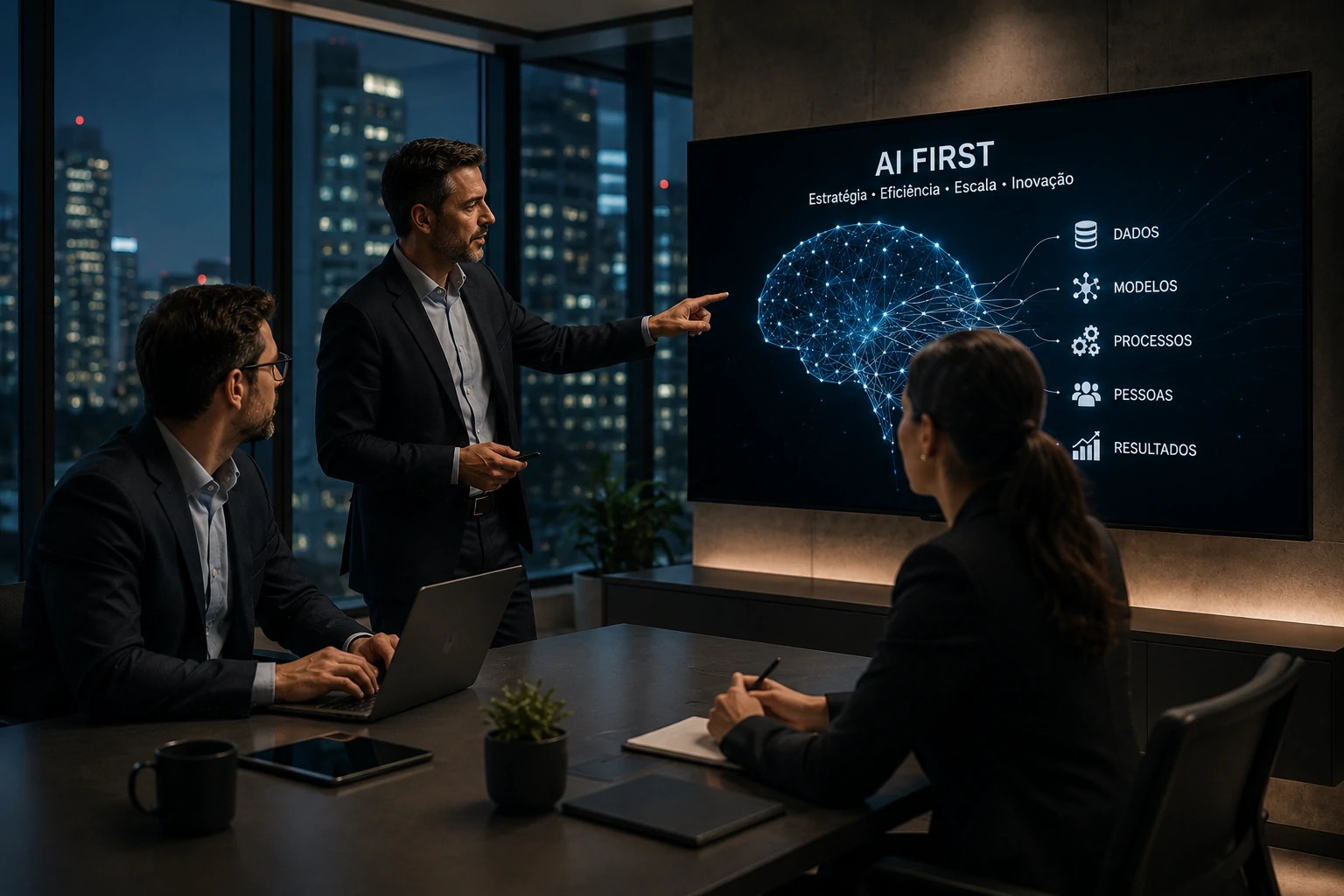
The primary objective of the AI First model is to transform artificial intelligence into a sustainable competitive advantage.
Higher Productivity
Professionals can accomplish more work with less operational effort.
Research, analysis, documentation, and repetitive tasks can be significantly accelerated.
This allows teams to focus their energy on higher-value strategic activities.
Better Decision-Making
AI models can analyze large volumes of information within seconds.
When implemented effectively, they help leaders identify patterns, risks, and opportunities more quickly.
Operational Scalability
Organizations can expand capacity without necessarily increasing headcount at the same pace.
This advantage has attracted growing interest from companies across technology, financial services, retail, and healthcare sectors.
What Challenges Prevent Companies from Becoming AI First?
Not every organization is prepared to adopt this approach.
Implementation requires cultural, technological, and organizational change.
Many initiatives fail because companies attempt to deploy AI without first preparing their infrastructure and processes.
Cultural Resistance
The primary challenge is often human rather than technical.
Employees may view AI as a threat instead of a capability-enhancing tool.
As a result, training and education become essential components of the transformation process.
The concept of AI Fluency as a Competitive Advantage in Artificial Intelligence becomes particularly relevant in this context.
Inadequate Infrastructure
Fragmented systems make AI integration significantly more difficult.
Organizations with siloed data environments and low levels of digital maturity face greater implementation complexity.
Governance and Security
The more AI participates in critical decisions, the greater the need for governance.
Issues related to privacy, regulatory compliance, and access control become increasingly important.
Will the Future of Business Be AI First?
The trend points toward continued expansion of AI First strategies across virtually every sector of the economy.
That does not mean every company will become entirely driven by artificial intelligence.
However, organizations that ignore this shift may face growing disadvantages in productivity, innovation, and competitiveness.
Just as digital transformation eventually became a business necessity, the strategic integration of AI is likely to become part of the operational infrastructure of modern enterprises.
The real competitive differentiator will probably not be access to artificial intelligence itself, but rather the ability to build an organization capable of operating, learning, and continuously evolving alongside it.
Comentários
Os comentários utilizam autenticação via GitHub para manter um ambiente mais qualificado, seguro e livre de spam.
Entrar ou criar conta no GitHub