
For years, CRM platforms evolved by adding automation, integrations and analytics. In 2026, however, the market entered a new phase: platforms capable of operating with AI agents that perform tasks much like digital employees. For businesses looking to improve productivity and remain competitive, understanding this shift has become a strategic priority.
CRM platforms are evolving from customer databases into intelligent AI workspaces

The newest generation of CRM platforms uses AI agents to execute sales, administrative and customer service tasks with contextual intelligence.
For decades, a CRM primarily served as a centralized system for storing customer information, tracking sales opportunities and managing the sales pipeline.
Today, the arrival of AI agents is transforming these platforms into intelligent work environments capable of completing entire business processes while dramatically reducing manual work.
What changes in practice?
Modern AI Employees can understand requests, retrieve CRM data, generate responses, update records, summarize meetings, qualify leads and even launch complete business workflows automatically.
Instead of simply storing customer information, the CRM becomes an active participant in daily business operations.
Why is this trend accelerating in 2026?
The rapid adoption of large language models has made it possible to embed conversational intelligence directly into enterprise software.
At the same time, organizations increasingly demand platforms that combine Artificial Intelligence, automation and customer relationship management within a unified ecosystem, improving efficiency while lowering operational costs.
This evolution complements the broader shift toward enterprise automation previously explored by Notícia Tech in its article about AI Orchestration:
How to choose a CRM platform built for AI agents

Leading CRM vendors are expanding beyond traditional automation by embedding intelligent AI agents across multiple business functions.
Selecting a CRM in 2026 is no longer just about comparing features.
The most important question has become: Will this platform be able to evolve alongside the next generation of Artificial Intelligence?
Essential capabilities to evaluate
When comparing solutions, organizations should prioritize platforms offering:
- native AI agents;
- integration with leading AI models;
- advanced workflow automation;
- AI-assisted content generation;
- predictive analytics;
- open API integrations;
- unified sales, marketing and customer service capabilities.
These characteristics are increasingly becoming the factors that separate future-ready CRM platforms from traditional software.
Vendors leading the AI transformation
Companies such as Salesforce, HubSpot, Microsoft Dynamics 365, Zoho CRM, Freshsales and Pipedrive are investing heavily in AI-driven capabilities.
Although each vendor follows a different strategy, they all share the same objective: enabling intelligent agents to automate repetitive work while significantly increasing employee productivity.
This market evolution also complements another Notícia Tech analysis comparing the best AI-powered CRM platforms, illustrating how Artificial Intelligence is already reshaping enterprise software purchasing decisions:
https://noticiatech.com.br/en/tools/best-ai-crms-2026-comparison-businesses/
The leading AI agent-powered CRM platforms in 2026
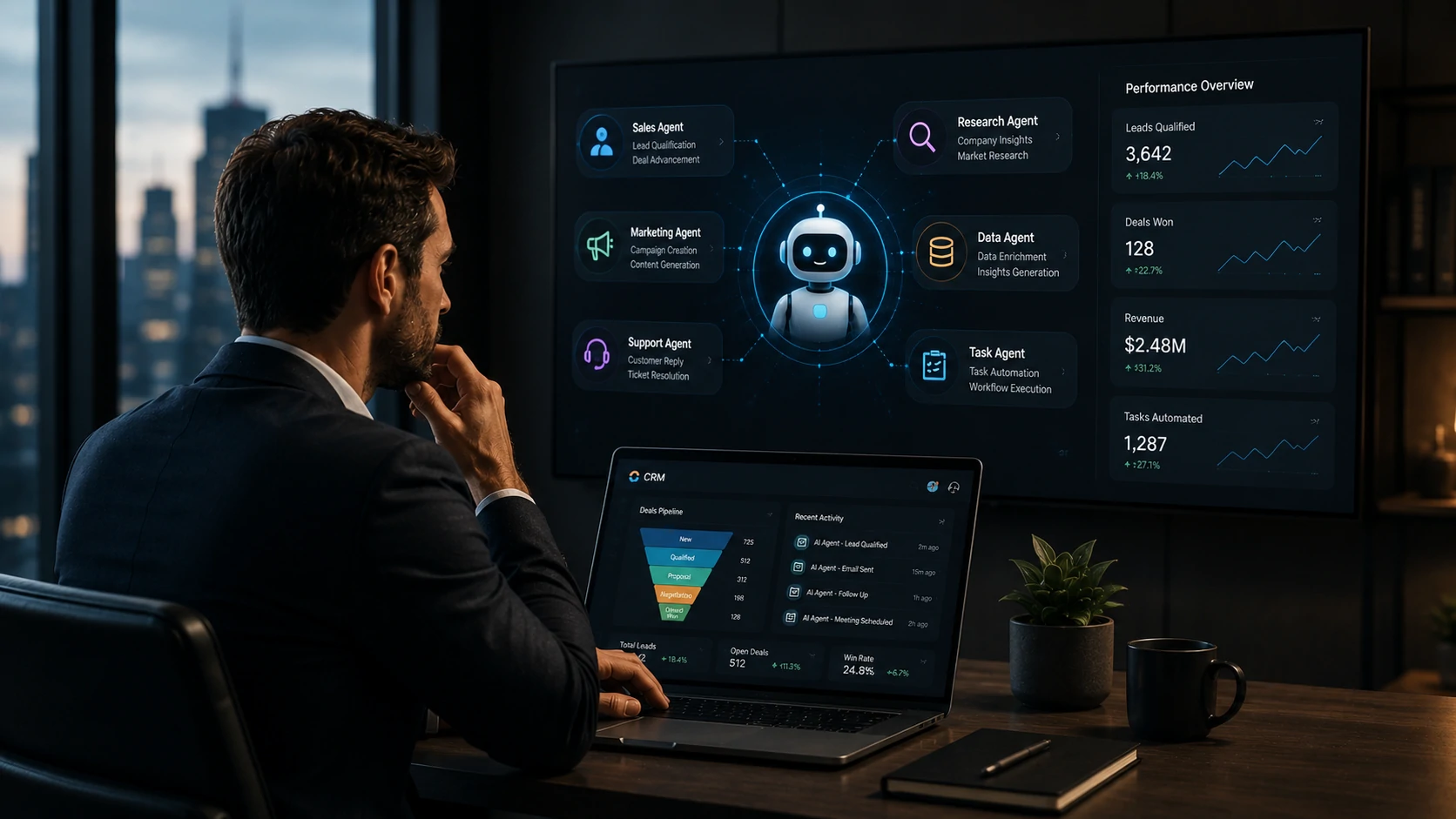
The world’s leading CRM vendors are competing by embedding AI agents, advanced automation and generative AI into their enterprise platforms.
Although every major CRM provider is investing heavily in Artificial Intelligence, each company is pursuing a different strategy to transform customer relationship management into an intelligent business workspace.
The ideal platform depends on company size, operational complexity and the level of automation required.
Salesforce
Salesforce continues to lead the enterprise CRM market by making AI agents a central part of its platform strategy.
Its ecosystem is designed for organizations that require extensive customization, complex business workflows and large-scale customer data management.
HubSpot
HubSpot remains one of the most accessible CRM solutions for small and medium-sized businesses.
Its AI capabilities support email generation, content creation, contact management, customer service and pipeline analysis, helping teams become productive more quickly.
Microsoft Dynamics 365
Microsoft Dynamics 365 strengthens its position through deep integration with the broader Microsoft ecosystem.
Its AI agents can work across documents, meetings, calendars and productivity tools, making it especially attractive for organizations already using Microsoft business applications.
Zoho CRM, Freshsales and Pipedrive
These vendors are rapidly expanding their AI investments.
Beyond traditional workflow automation, they are introducing intelligent agents capable of recommending sales actions, summarizing customer interactions and supporting decision-making throughout the sales cycle.
Regardless of which platform a business selects, one trend is becoming increasingly clear: CRM software is evolving into a collaborative environment where employees and AI agents work together to improve business performance.
The future of CRM will be shaped by AI Employees
Over the next few years, enterprise CRM platforms are expected to evolve into intelligent operational hubs where AI agents collaborate with human teams across sales, marketing and customer service.
In this environment, competitive advantage will no longer come solely from storing customer information. Instead, success will depend on a CRM’s ability to execute tasks, understand business context and assist decision-making in real time.
Organizations that begin this transition earlier are likely to gain significant advantages through increased automation, lower operational costs and faster responses to changing market conditions.
At the same time, choosing a CRM will become less about today’s feature list and more about a vendor’s long-term AI strategy, ecosystem integration and ability to support increasingly capable intelligent agents.
This transformation aligns with another Notícia Tech analysis on AI Process Automation, which explains how Artificial Intelligence is reshaping business process automation.
Likewise, understanding the concept of AI Fluency is becoming essential for executives and business leaders who want to maximize the value of these next-generation enterprise platforms.
As AI Employees continue to mature, CRM platforms are expected to become the central interface connecting people, business processes and Artificial Intelligence. For organizations planning sustainable growth over the coming years, investing in a platform designed for this new generation of intelligent agents may prove to be one of the most important technology decisions they make.
Comentários
Os comentários utilizam autenticação via GitHub para manter um ambiente mais qualificado, seguro e livre de spam.
Entrar ou criar conta no GitHub