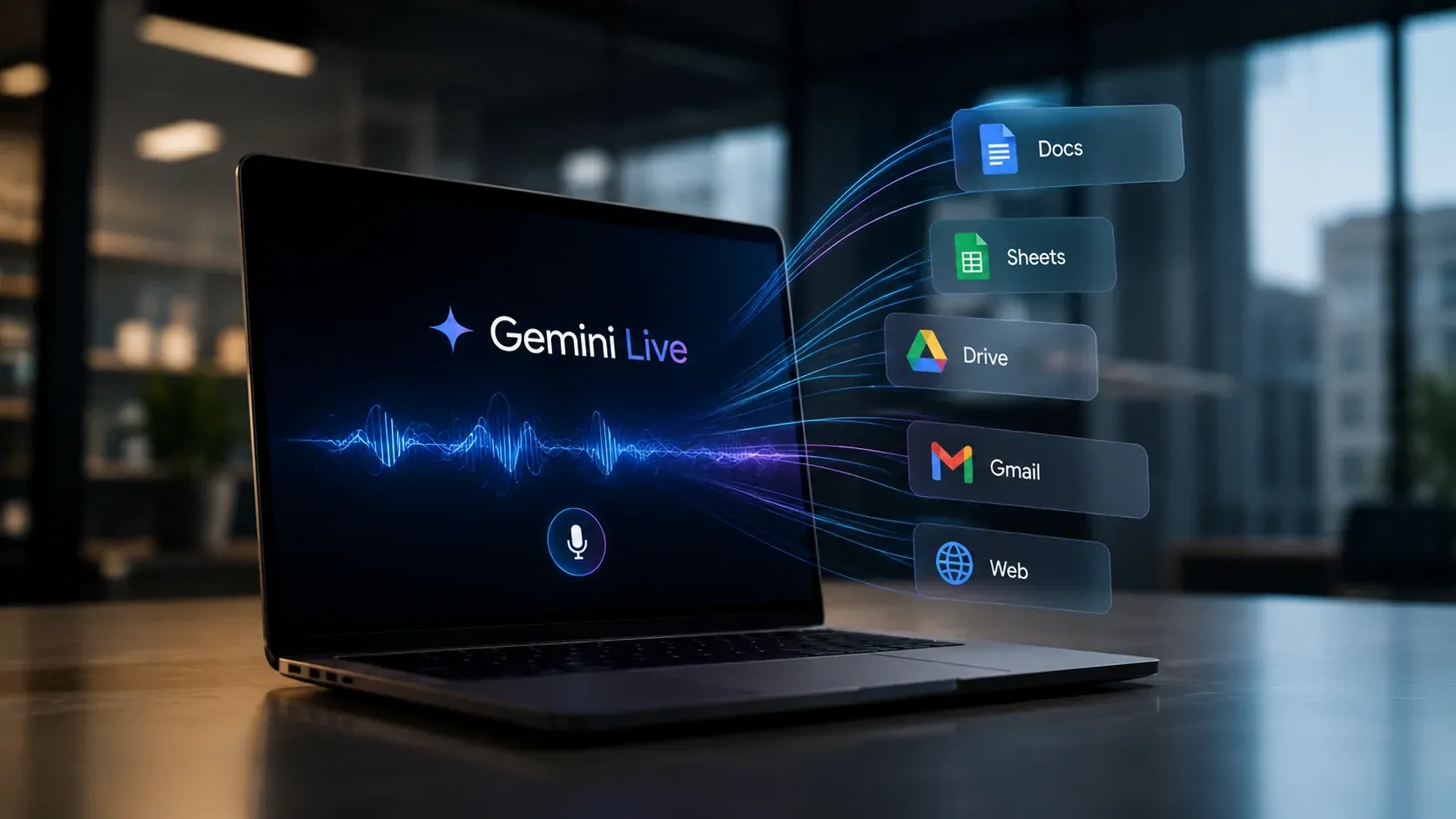
Google is pushing Gemini Live beyond simple conversation. By connecting its voice experience with Gemini Spark, the company is turning natural-language commands into tasks that can continue running in the background, bringing the Gemini app closer to becoming a personal automation layer.
Gemini Live is moving from conversation to execution
On August 26, Google announced new capabilities for Gemini Live that change what users can expect from a voice-based AI assistant.
Instead of simply answering a question, Gemini Live can now interpret a broader objective and delegate complex work to Gemini Spark, Google’s personal AI agent.
The distinction matters because the user no longer has to manually guide the AI through every step of a workflow. A conversation can become the starting point for a task that continues after the voice interaction ends.
From asking questions to delegating work
Traditional chatbots are mainly designed around a request-and-response model. The user asks something, the AI generates an answer and the interaction ends.
An AI agent works differently. It can receive an objective, determine a sequence of actions, use connected tools and continue working until the task reaches a defined stage.
That is the direction Google is taking with the combination of Gemini Live and Gemini Spark.
The role of Gemini Spark
Gemini Spark is designed as a 24/7 personal AI agent capable of working across Google’s ecosystem.
It can interact with tools such as Gmail, Google Docs, Google Sheets and Google Drive, while also using the web for certain tasks. Because Spark operates in the cloud, it can continue working even when the user’s computer is closed or phone is locked.
Connecting Spark to Gemini Live changes the entry point. Instead of opening a separate agent interface and configuring a task, users can describe what they want through a conversation.
Voice can now trigger background tasks
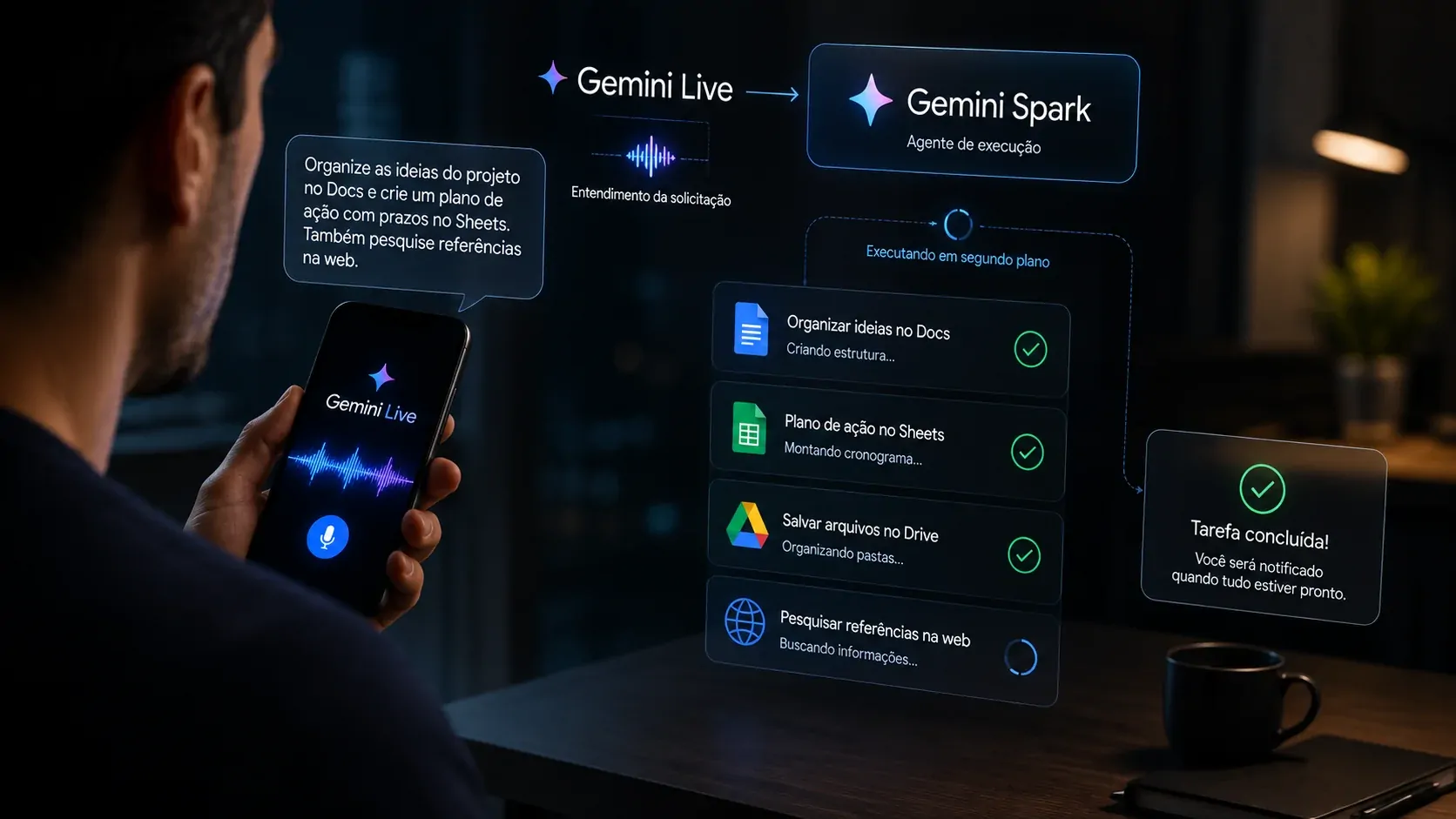
Gemini Live can turn a spoken request into a multi-step task that Gemini Spark continues executing in the background.
The practical difference is significant. A user can explain an idea out loud and ask Gemini to turn it into an organized document, for example.
The system can also handle more complex workflows involving information stored across Google’s applications. Instead of generating a single answer, the agent can coordinate multiple actions.
The important development is therefore not any individual task. It is the ability to delegate a process instead of requesting one action at a time.
Why background execution matters
Background execution changes the relationship between the user and the AI.
A conventional chatbot requires the user to remain in the interaction. A background agent can continue processing the assigned task after the conversation is over.
That makes Gemini Spark closer to an automation platform than a conventional assistant.
The user provides the objective, while the agent handles the operational steps within the permissions and applications it has been given access to.
From generation to workflow automation
This also changes the definition of productivity with generative AI.
For years, the main productivity gains came from generating text, summarizing information, creating images or answering questions faster.
Agentic systems introduce another layer: executing workflows.
The potential benefit is not simply producing content faster. It is removing repetitive steps between an idea and its completion.
Gmail becomes another surface for voice-controlled actions
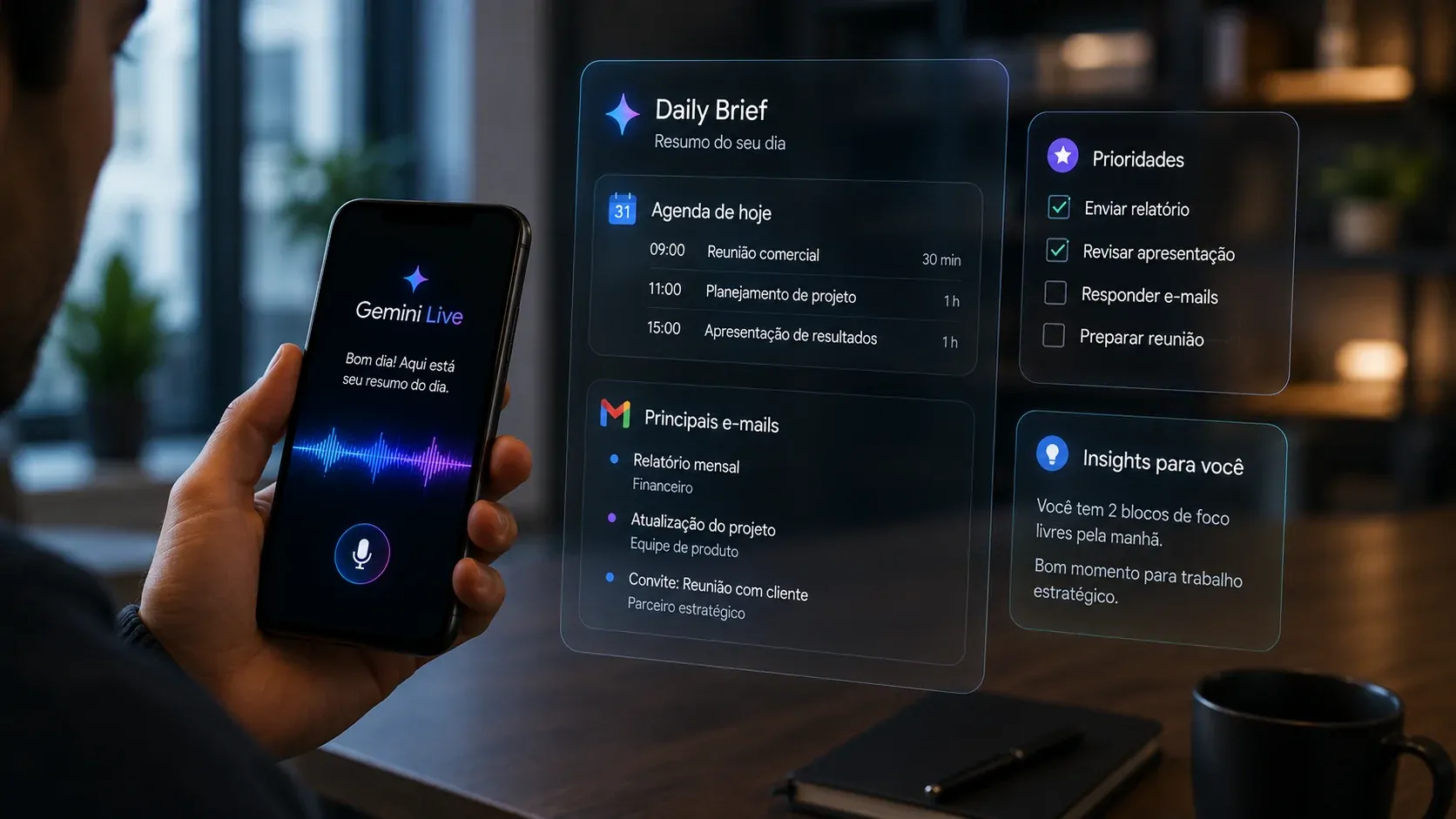
Gemini Live expands voice interaction into Gmail, reducing the need to manually navigate the inbox.
Google is also expanding the role of Gemini Live in Gmail.
Users can ask questions about their inbox, search for information contained in messages and receive synthesized answers without manually opening individual emails.
The broader goal is to make Gmail accessible through natural language rather than requiring users to remember where information is stored.
That becomes particularly useful when email is only one part of a larger task.
The inbox becomes a source of context
The importance of the integration goes beyond voice commands.
Email contains information about meetings, purchases, projects, deadlines, travel and other activities. When an AI system can access that information with permission, it gains context that can be used to support more complex tasks.
This is one of the foundations of Google’s broader Personal Intelligence strategy.
Instead of treating every prompt as an isolated request, the system can connect information across the user’s digital environment.
Personal Intelligence expands the context layer
Personal Intelligence allows Gemini to use information from connected Google applications and previous interactions to provide more contextual responses.
That creates an important distinction between a general-purpose chatbot and an assistant embedded in a user’s digital life.
The more context an AI can access, the more useful it can potentially become. But the same capability also increases the importance of permissions, privacy controls and user confirmation.
For businesses, that balance will be particularly important when AI agents gain access to corporate email, documents and other sensitive systems.
Daily Brief turns Gemini into a routine assistant
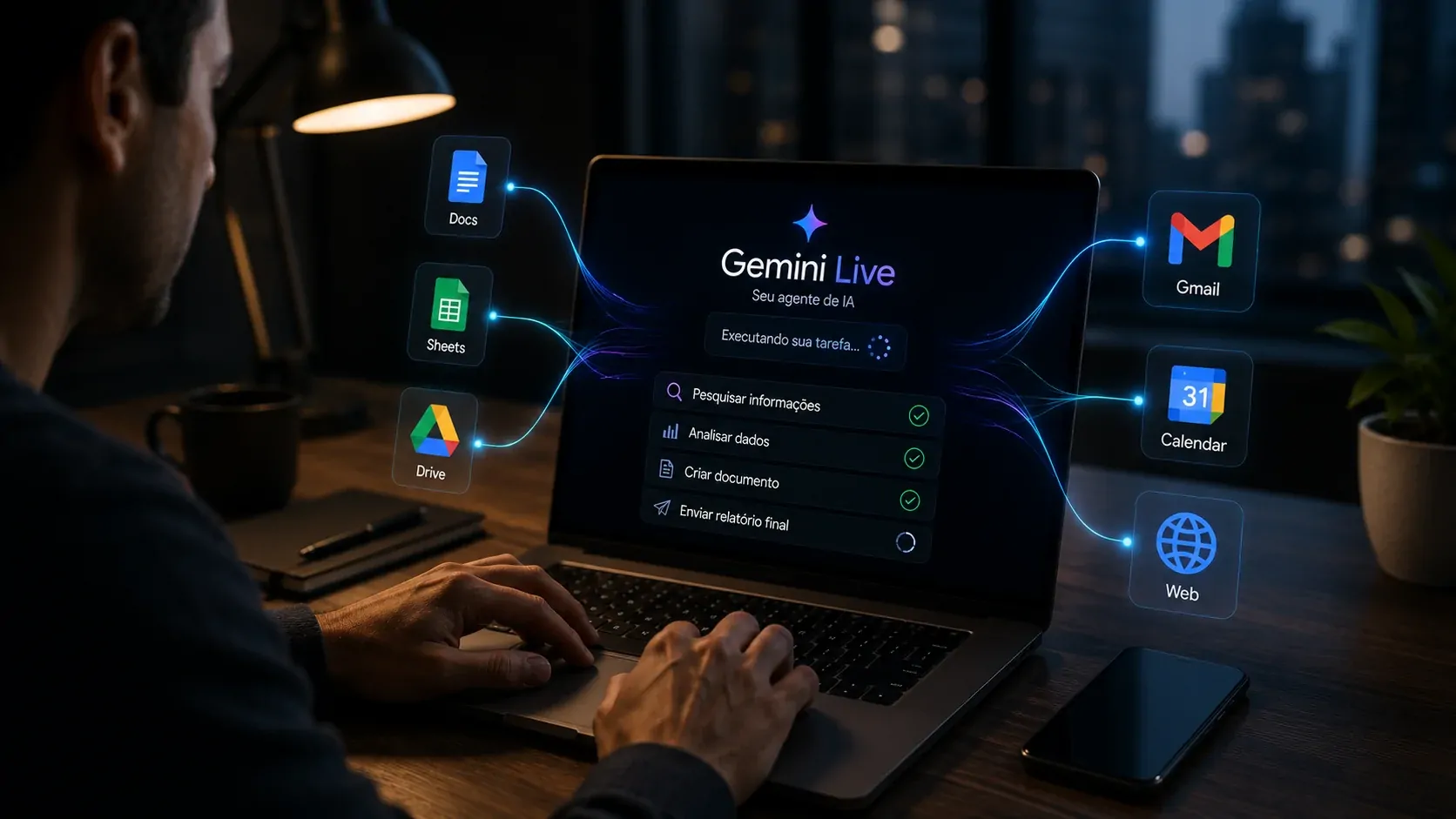
Daily Brief combines information from connected services to give users a personalized view of their day.
Another important part of the update is Daily Brief, which turns Gemini into a more proactive assistant for everyday routines.
Rather than waiting for a specific question, Daily Brief can organize relevant information from connected services such as Gmail and Google Calendar into a personalized morning briefing.
The goal is not simply to summarize information. Gemini can prioritize what appears important and suggest potential next steps.
That moves the product closer to an assistant that helps organize the user’s day instead of merely responding when prompted.
Context becomes part of the product
This approach reflects a broader shift in AI products.
The competitive advantage is increasingly moving beyond the underlying model and toward the combination of context, tools, permissions and execution.
A model may be highly capable at generating an answer, but an agent becomes more valuable when it can use that answer to perform work.
That is why Google’s integration of Gemini Live with Spark matters strategically.
The AI competition is moving toward agents
The shift also changes the competitive landscape.
Google, OpenAI and Anthropic are increasingly competing not only on model quality but also on their ability to build systems that can use tools and execute multi-step workflows.
The market is gradually moving from the question “Which AI gives the best answer?” toward “Which AI can actually complete the task?”
This transition is already visible across the industry.
The same shift can be seen in AI research and document workflows. Mistral bets on agentic search for complex documents shows how AI companies are moving toward systems that can perform longer, more structured processes instead of returning a single response.
What Gemini’s evolution means for businesses
The combination of Gemini Live, Gemini Spark, Gmail, Docs, Sheets, Drive and Personal Intelligence points toward a broader change in how AI can interact with software.
The evolution of Gemini brings conversational AI closer to a layer capable of coordinating multiple productivity tools.
For businesses, the strategic implication is straightforward: AI is moving from a productivity tool into a potential execution layer.
Instead of configuring every step manually, employees may increasingly describe the desired outcome and allow an agent to coordinate parts of the workflow.
That does not mean companies should hand complete control of critical systems to AI agents.
Tasks involving sensitive information, financial decisions, external communications or irreversible actions still require appropriate permissions, confirmation mechanisms and oversight.
Productivity is becoming execution
The biggest change is the definition of what an AI assistant is expected to do.
A few years ago, productivity with AI largely meant writing faster, summarizing documents or finding information.
The emerging agentic model goes further. The system can receive an objective, access tools, process information and execute multiple steps.
That creates the possibility of automating parts of a workflow that previously required a human to coordinate several applications manually.
Governance becomes more important as autonomy increases
Greater autonomy also creates a greater need for governance.
Companies will need to determine which applications agents can access, which actions require human confirmation and how agent activity should be monitored and recorded.
The technical ability to execute a task is only one part of the problem. The other is ensuring that execution remains within organizational policies and permissions.
This issue becomes increasingly important as agents gain access to email, documents, calendars and other systems containing sensitive business information.
Gemini Live is still presented as a conversational voice experience, but its connection to Gemini Spark changes what that interface represents.
When a conversation can trigger an agent, access connected applications and start work that continues in the background, the assistant moves beyond simply answering questions.
The strategic question is now whether Google can turn the combination of voice, context, tools and autonomous execution into an experience reliable enough to become part of everyday work.
That is where the next stage of the AI agent race is likely to be decided.
Comentários
Os comentários utilizam autenticação via GitHub para manter um ambiente mais qualificado, seguro e livre de spam.
Entrar ou criar conta no GitHub