
As organizations move beyond using artificial intelligence as a simple chatbot and begin embedding AI into daily business operations, the need for a standardized integration layer becomes increasingly important. This is exactly where MCP servers are emerging as one of the most promising architectures for connecting AI models to enterprise systems.
What Is an MCP Server and Why It Matters for Businesses
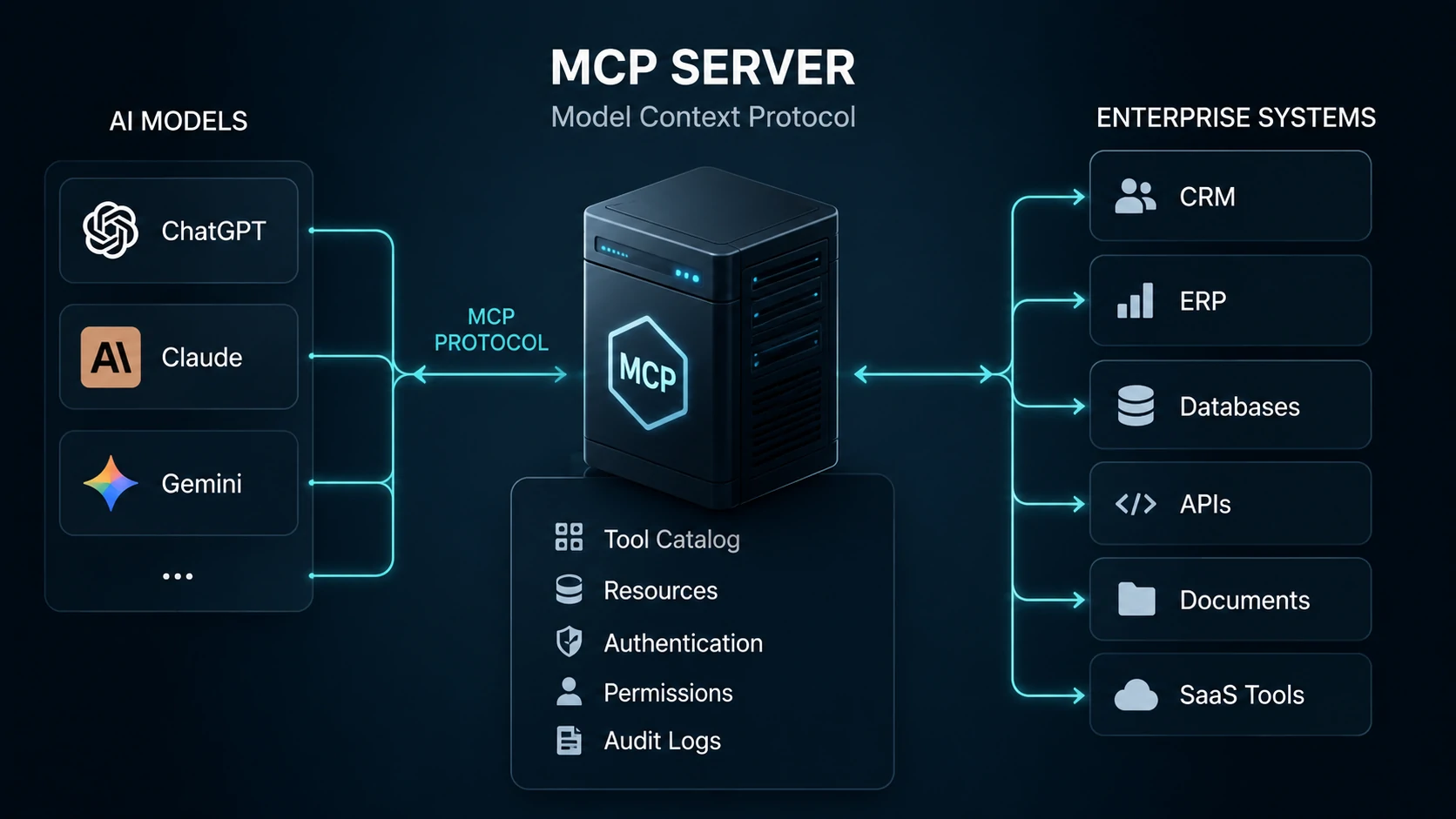
An MCP server acts as the integration layer between AI models and enterprise applications.
The Model Context Protocol (MCP) was designed to solve one of the biggest challenges facing enterprise AI adoption: every large language model traditionally required its own custom integration to access internal systems, databases, and business applications.
In practice, an MCP server becomes the communication layer between AI models and enterprise resources. Instead of developing separate integrations for ChatGPT, Claude, Gemini, and future models, organizations expose their resources through a single standardized protocol.
This architecture lowers development costs, improves governance, and makes it significantly easier to adopt new AI providers without rebuilding existing integrations.
The role of an MCP server
An enterprise MCP server typically centralizes access to:
- corporate APIs;
- relational databases;
- internal documentation;
- ERP platforms;
- CRM systems;
- SaaS applications;
- authentication services.
Instead of answering questions solely from its pretrained knowledge, the AI becomes capable of retrieving live business information and executing authorized actions.
Why enterprises are adopting MCP
The trend mirrors the evolution of REST APIs years ago. Standardization reduces engineering complexity while improving long-term scalability.
Organizations already investing in AI agent architectures often expand toward concepts discussed in What Is AI Orchestration? Why It Is Replacing the Competition Between AI Models in Business, where multiple AI models operate on top of a shared infrastructure.
How an MCP Server Architecture Works
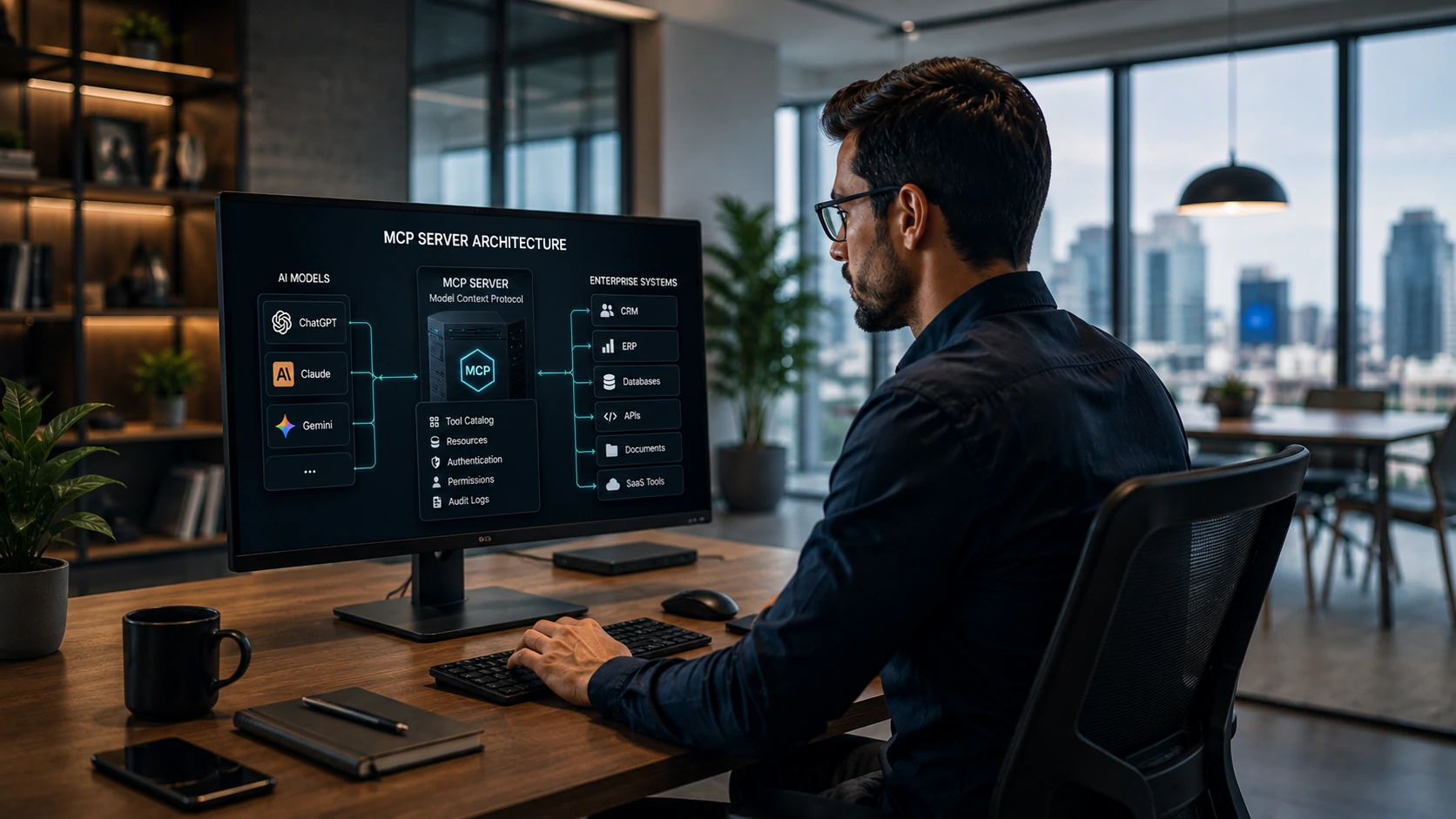
An MCP server orchestrates communication between AI models and enterprise systems.
Rather than connecting an AI model directly to an ERP or CRM platform, the architecture usually follows four logical stages.
A user submits a request to an AI assistant.
The AI determines that it needs a tool exposed by the MCP server.
The MCP server executes the requested operation within the enterprise system.
The processed result is returned to the AI model, which generates the final response.
Logical workflow
User

↓

AI Model

↓

MCP Server

↓

API / ERP / CRM / Database

↓

Structured Response

↓

AI Model

↓

User
This separation allows organizations to switch AI providers in the future without redesigning every enterprise integration.
Companies already deploying business automation can also combine MCP with strategies presented in How to Use AI for B2B Lead Qualification, extending AI capabilities across commercial workflows.
Core components
A production-ready MCP server typically includes:
- tool catalog;
- resource definitions;
- authentication;
- permission management;
- audit logging;
- API integrations.
How to Build an MCP Server in Practice
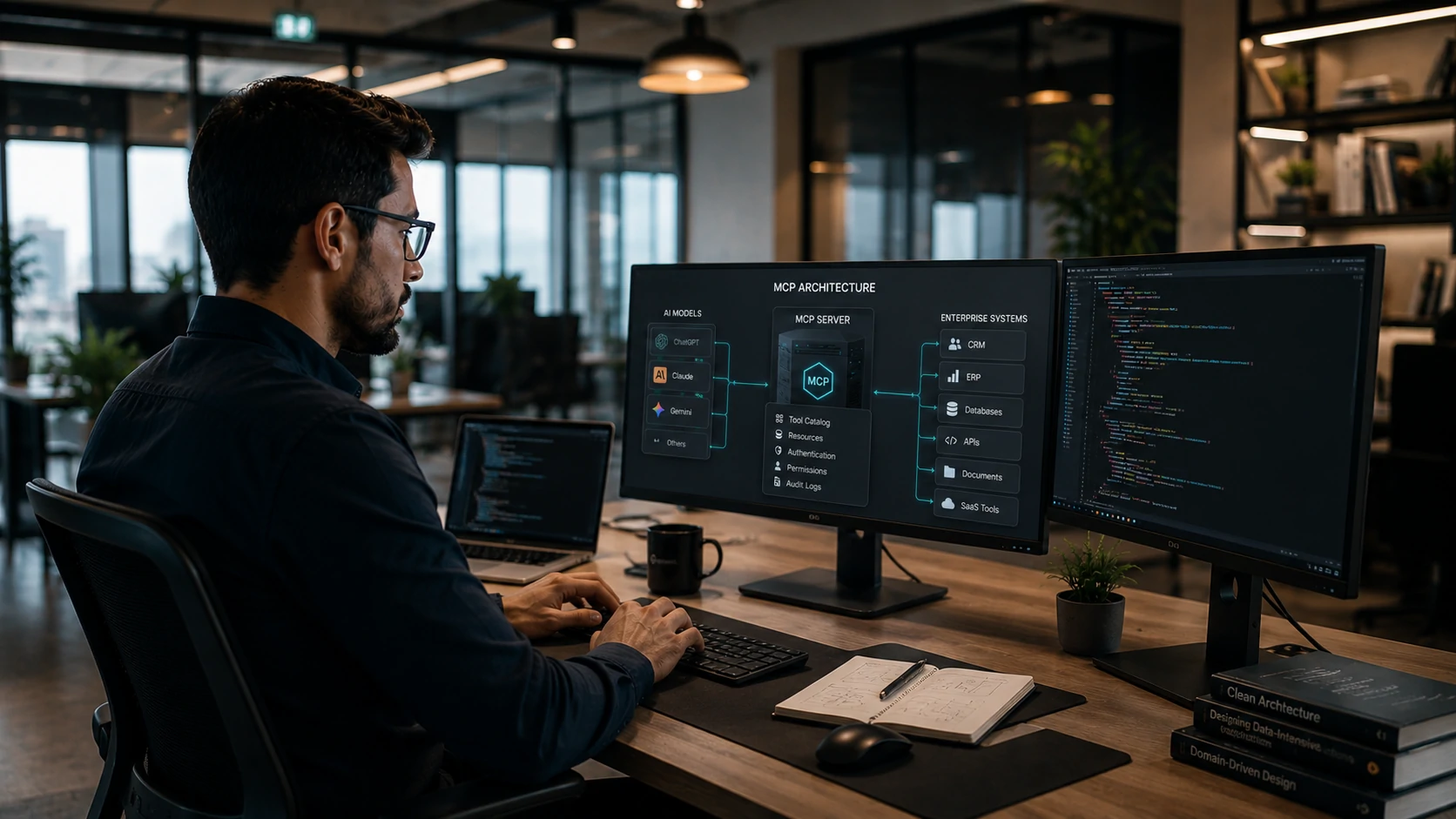
A simplified enterprise architecture showing how an MCP server exposes business tools and resources to AI models.
Building an MCP server involves much more than installing a software library. The primary objective is to determine which enterprise resources should be exposed to AI models and how access to those resources will be secured.
Most successful implementations begin with a limited scope before gradually expanding to additional business systems.
Step 1 — Define the available tools
The first task is identifying which business capabilities the AI should be able to use.
Typical examples include:
- retrieving customer information from a CRM;
- opening support tickets;
- searching internal documentation;
- checking inventory levels;
- generating business reports;
- querying financial dashboards.
Starting with a small number of tools simplifies testing and reduces operational risk.
Step 2 — Connect enterprise APIs
The MCP server then integrates with existing enterprise APIs.
Rather than allowing AI models to communicate directly with internal systems, the server centralizes those connections and controls exactly which operations can be executed.
This architecture improves both governance and long-term maintainability.
Step 3 — Configure authentication and permissions
Not every AI assistant should have unrestricted access to enterprise information.
A production deployment should define policies such as:
- read-only access;
- department-based permissions;
- OAuth authentication;
- audit logging;
- activity monitoring.
These controls reduce security risks while supporting regulatory compliance and internal governance.
Example prompt for testing an MCP server
Once the server is operational, organizations can validate the integration with a structured prompt like the following:
You have access to the company's MCP server.

Identify the five customers with the highest revenue during the last quarter.

Return:

- Company name
- Revenue
- Industry
- Account manager

Present the results as a table and identify potential expansion opportunities.
This example demonstrates how the AI interacts with live enterprise data instead of relying exclusively on pretrained knowledge.
Limitations, Security, and the Human-in-the-Loop Approach
Although MCP greatly simplifies enterprise AI integration, it does not eliminate the need for human oversight.
Generative AI models may still misunderstand requests, invoke the wrong tools, or produce inaccurate conclusions when business data is incomplete or ambiguous.
For this reason, critical business workflows should always incorporate a Human-in-the-Loop process, where a qualified employee reviews important decisions before automated actions are executed.
Recommended best practices include:
- limiting permissions by user role;
- recording every MCP request;
- validating AI-generated responses before executing critical operations;
- reviewing exposed tools and resources regularly.
This combination of automation and human supervision significantly improves reliability while reducing operational risks.
The Future of MCP Servers in Enterprise AI
Artificial intelligence is rapidly moving toward an ecosystem where multiple foundation models share the same enterprise integration layer.
Instead of maintaining separate connectors for every AI platform, organizations will increasingly invest in standardized architectures capable of serving multiple assistants simultaneously.
Within this landscape, the Model Context Protocol represents far more than another technical specification. It provides an interoperability layer that simplifies enterprise AI adoption, lowers integration costs, and prepares businesses for future advances in foundation models.
As new AI platforms emerge, companies that have already implemented MCP servers will be able to adopt them with minimal engineering effort instead of rebuilding their entire integration stack. For organizations treating artificial intelligence as a long-term digital transformation strategy, this flexibility is likely to become a significant competitive advantage.
Comentários
Os comentários utilizam autenticação via GitHub para manter um ambiente mais qualificado, seguro e livre de spam.
Entrar ou criar conta no GitHub