As AI agents become part of everyday business operations rather than experimental projects, automation platforms are evolving into strategic infrastructure. In this environment, n8n and Zapier have emerged as two of the market’s leading solutions, each targeting different business priorities and levels of technical maturity.
Businesses of every size are accelerating investments in intelligent automation. The rapid adoption of AI agents, large language models (LLMs) and connected enterprise applications has transformed workflow automation platforms into critical components of modern digital operations.
While Zapier has established itself as the leading no-code automation platform, n8n has rapidly gained popularity thanks to its flexibility, developer-friendly architecture and self-hosting capabilities. Choosing between the two is no longer simply a matter of comparing integration libraries.
Instead, organizations must evaluate scalability, governance, AI capabilities and long-term operational costs.
This guide explores the key factors business leaders, IT professionals and digital transformation teams should consider before selecting an automation platform in 2026.
n8n and Zapier serve different enterprise automation strategies
Both platforms automate repetitive tasks, but they were designed with different audiences and business objectives in mind.
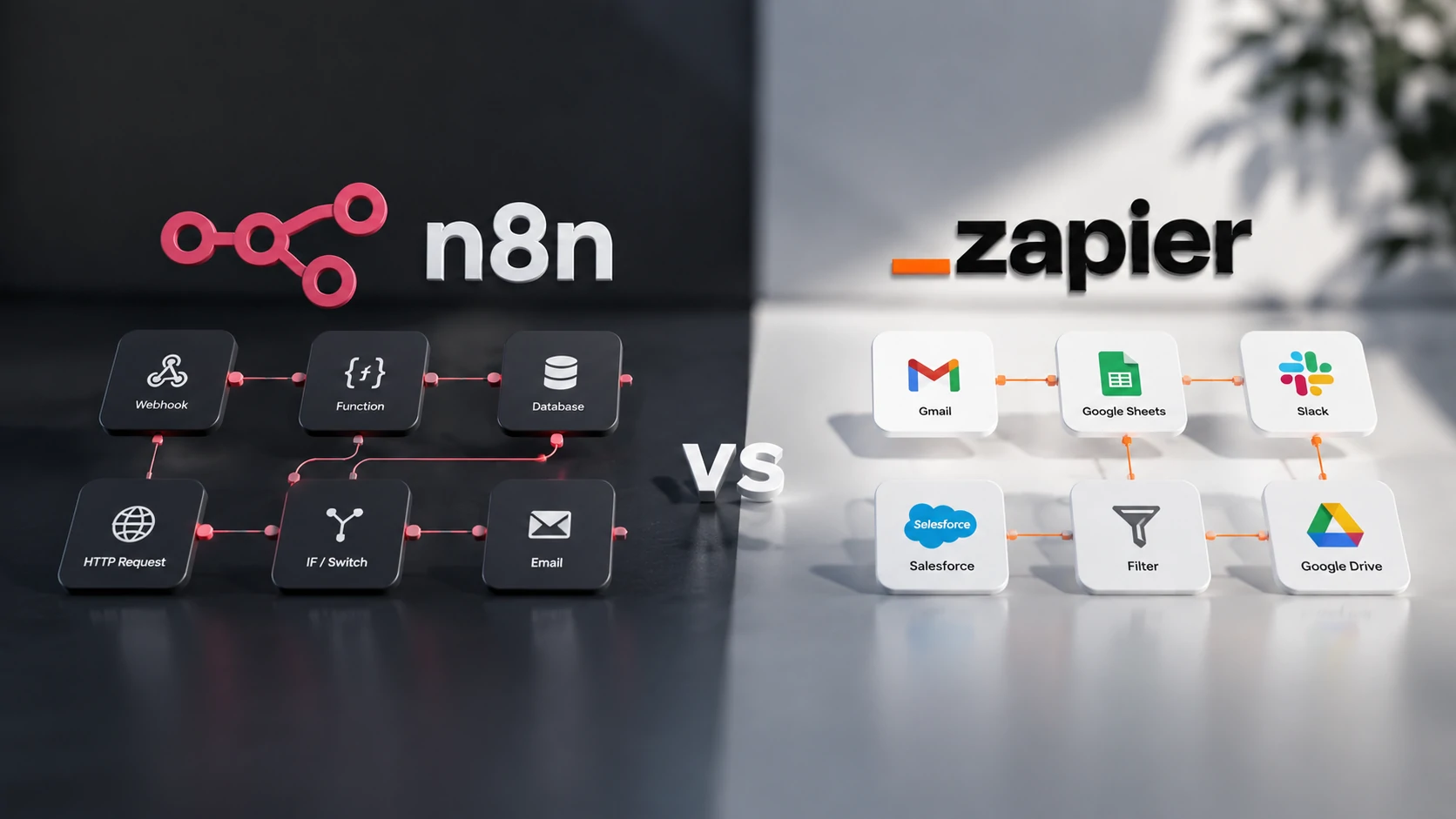
The architectural differences between the two platforms directly influence flexibility, scalability and long-term automation costs.
Zapier focuses on simplicity.
Its intuitive interface allows users to connect CRM systems, email platforms, spreadsheets, project management software and thousands of SaaS applications without writing code.
In contrast, n8n was built with flexibility at its core. It enables organizations to create sophisticated workflows, execute conditional logic, connect APIs, interact with databases and even write custom JavaScript when advanced functionality is required.
When Zapier is the better choice
Companies seeking rapid deployment and minimal technical complexity often achieve excellent results with Zapier.
Its primary advantages include:
- intuitive workflow builder;
- thousands of prebuilt integrations;
- minimal learning curve;
- excellent experience for business users.
These capabilities make Zapier particularly attractive for marketing, sales, operations and customer success teams that want to automate processes without relying heavily on software developers.
When n8n becomes the stronger option
n8n is often the preferred platform for organizations that require complete control over their automation infrastructure.
Its main strengths include:
- self-hosting capabilities;
- extensive workflow customization;
- advanced API integrations;
- execution of custom code;
- lower operational costs at enterprise scale.
As a result, businesses deploying AI agents, MCP architectures, proprietary integrations or complex internal systems frequently obtain greater long-term value from n8n.
If you would like to understand how modern AI integration architectures work, read our complete guide:
https://noticiatech.com.br/en/artificial-intelligence/how-mcp-works-complete-guide-ai-agents/
Artificial intelligence is widening the gap between both platforms
Generative AI has fundamentally changed the role of workflow automation.

Automation is no longer limited to connecting software applications. Modern platforms increasingly orchestrate intelligent AI agents capable of making decisions, interpreting documents and executing complex workflows.
Today’s organizations expect far more than simple application integrations. They want to orchestrate OpenAI, Claude, Gemini, open-source language models and autonomous AI agents within the same operational environment.
Although both Zapier and n8n have rapidly expanded their AI capabilities, each platform follows a distinct strategy.
Zapier’s AI-first user experience
Zapier has introduced AI-powered features that simplify workflow creation through natural language.
Its objective is to allow business professionals to design intelligent automations without requiring advanced programming knowledge, significantly reducing implementation time.
This approach makes Zapier particularly appealing to organizations prioritizing speed, usability and operational efficiency.
Why developers increasingly choose n8n for AI agents
Meanwhile, n8n has become one of the preferred orchestration platforms among AI engineers and technical teams.
Its architecture supports advanced AI agent development, LLM integrations, Retrieval-Augmented Generation (RAG) pipelines, enterprise APIs and sophisticated orchestration across multiple systems.
This evolution aligns with a broader industry trend discussed in our guide on implementing Model Context Protocol (MCP) within enterprise environments:
Pricing, scalability and security determine the right platform for each business
The best long-term value depends on a company’s technical maturity, workflow volume and customization requirements.
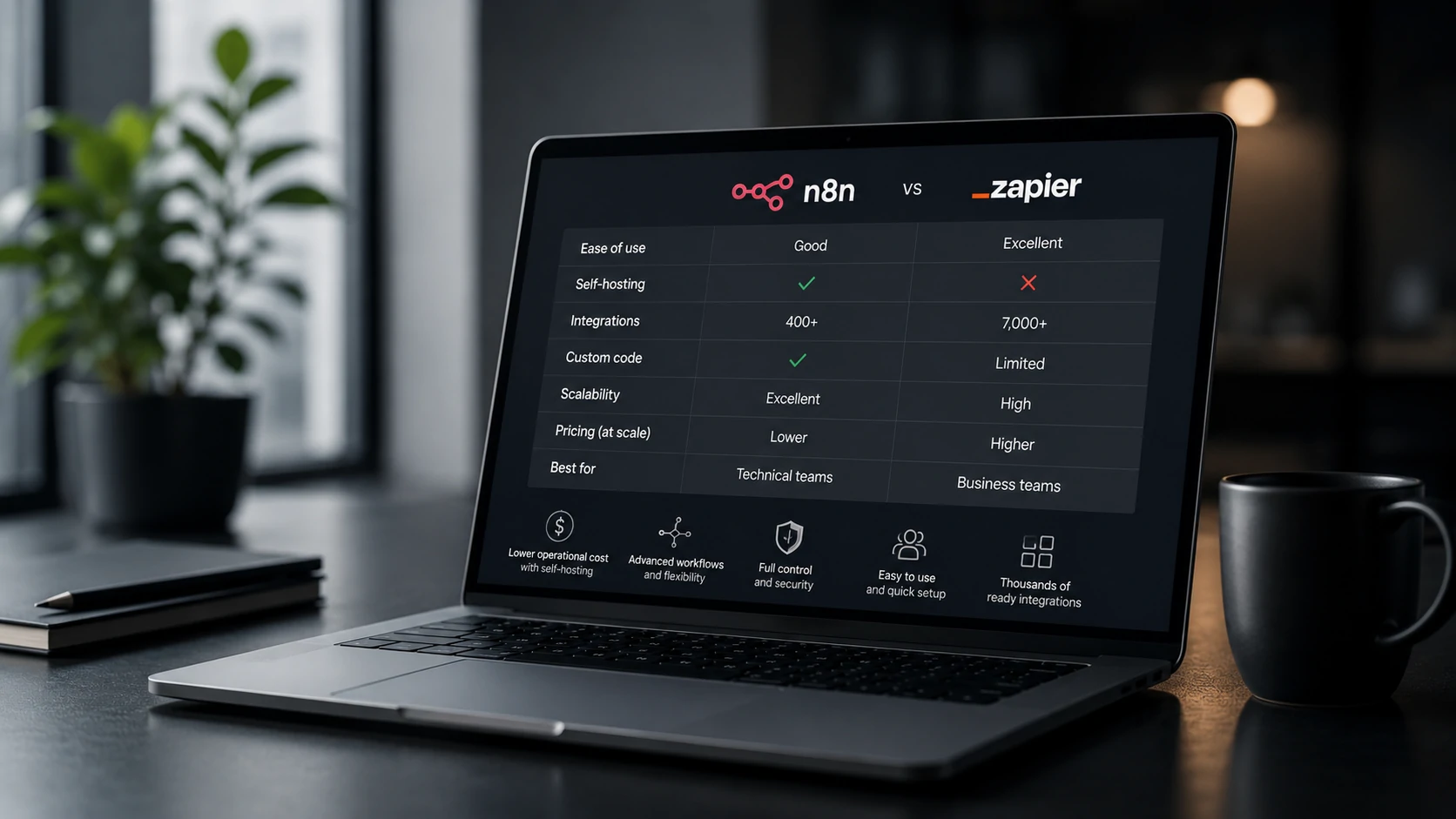
Beyond subscription costs, organizations should evaluate operational expenses, scalability and data governance before choosing an automation platform.
Although Zapier offers one of the fastest onboarding experiences in the automation market, businesses executing thousands of workflows every month may experience increasing subscription costs as operations expand.
By contrast, n8n generally requires more technical expertise during implementation but can significantly reduce long-term operating costs when deployed on a company’s own infrastructure.
n8n vs Zapier comparison
| Feature | n8n | Zapier |
|---|---|---|
| Ease of use | Good | Excellent |
| Learning curve | Moderate | Low |
| Self-hosting | Yes | No |
| Customization | Excellent | Good |
| API integrations | Excellent | Very Good |
| Custom code support | Yes | Limited |
| Enterprise scalability | Excellent | High |
| Best suited for | Technical teams | Business users |
In practice, small and medium-sized businesses often value Zapier’s simplicity and fast implementation, while organizations building digital products, AI agents or complex enterprise workflows frequently achieve greater long-term value with n8n.
Security is another critical differentiator
Security and governance have become increasingly important as AI systems gain access to sensitive business information.
By deploying n8n Self-Hosted, organizations retain complete control over workflow execution, infrastructure and corporate data, simplifying compliance with privacy regulations and internal governance policies.
This capability can represent a significant competitive advantage for industries such as finance, healthcare, manufacturing and government.
Meanwhile, Zapier provides a fully managed cloud environment that minimizes infrastructure maintenance but places workflow execution within the vendor’s ecosystem.
Which automation platform is the better choice in 2026?
There is no universal answer.
The right decision depends entirely on an organization’s business objectives, technical capabilities and long-term AI strategy.
Choose Zapier if your company prioritizes
- rapid implementation;
- minimal technical maintenance;
- straightforward business automations;
- fast productivity gains;
- non-technical operational teams.
Choose n8n if your company needs
- enterprise AI agents;
- advanced API integrations;
- lower infrastructure costs at scale;
- complete control over automation environments;
- highly customized enterprise workflows.
As enterprise AI adoption accelerates, workflow automation platforms are evolving beyond simple application connectors.
Increasingly, they serve as orchestration layers capable of coordinating LLMs, enterprise databases, APIs and autonomous AI agents across entire organizations.
Understanding technologies such as Retrieval-Augmented Generation (RAG) is becoming equally important, since modern AI agents rely on external knowledge sources to generate accurate and up-to-date responses.
Learn more in our complete guide:
Organizations planning to move beyond isolated automations should also understand the growing role of autonomous AI systems.
Our comprehensive guide to Agentic AI explores how intelligent agents are reshaping enterprise operations:
https://noticiatech.com.br/en/artificial-intelligence/what-is-agentic-ai-complete-guide-ai-agents/
Rather than asking which platform is objectively better, companies should determine which solution best aligns with their digital transformation strategy. Businesses focused on rapid deployment and operational simplicity will likely continue to benefit from Zapier. Those treating automation as strategic infrastructure for enterprise AI will often find n8n better positioned to support the next generation of intelligent business operations.
Comentários
Os comentários utilizam autenticação via GitHub para manter um ambiente mais qualificado, seguro e livre de spam.
Entrar ou criar conta no GitHub