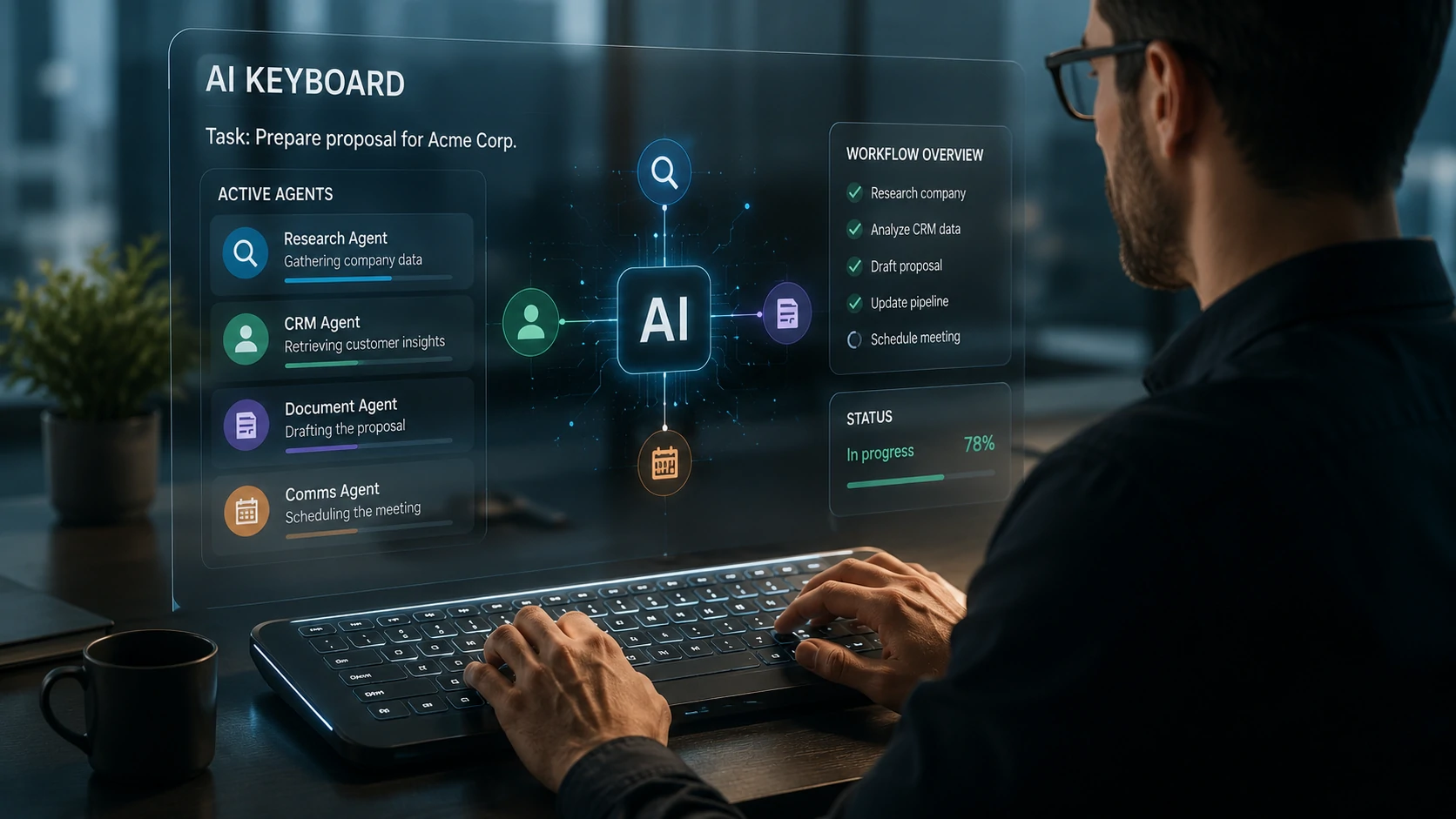
Artificial intelligence agents are evolving rapidly, yet the way people interact with them still resembles the chatbot era. OpenAI’s AI Keyboard initiative suggests a fundamental shift: instead of being just another text input, the interface could become a command center capable of coordinating intelligent agents throughout an entire workday.
What Is AI Keyboard and Why This Interface Is Different
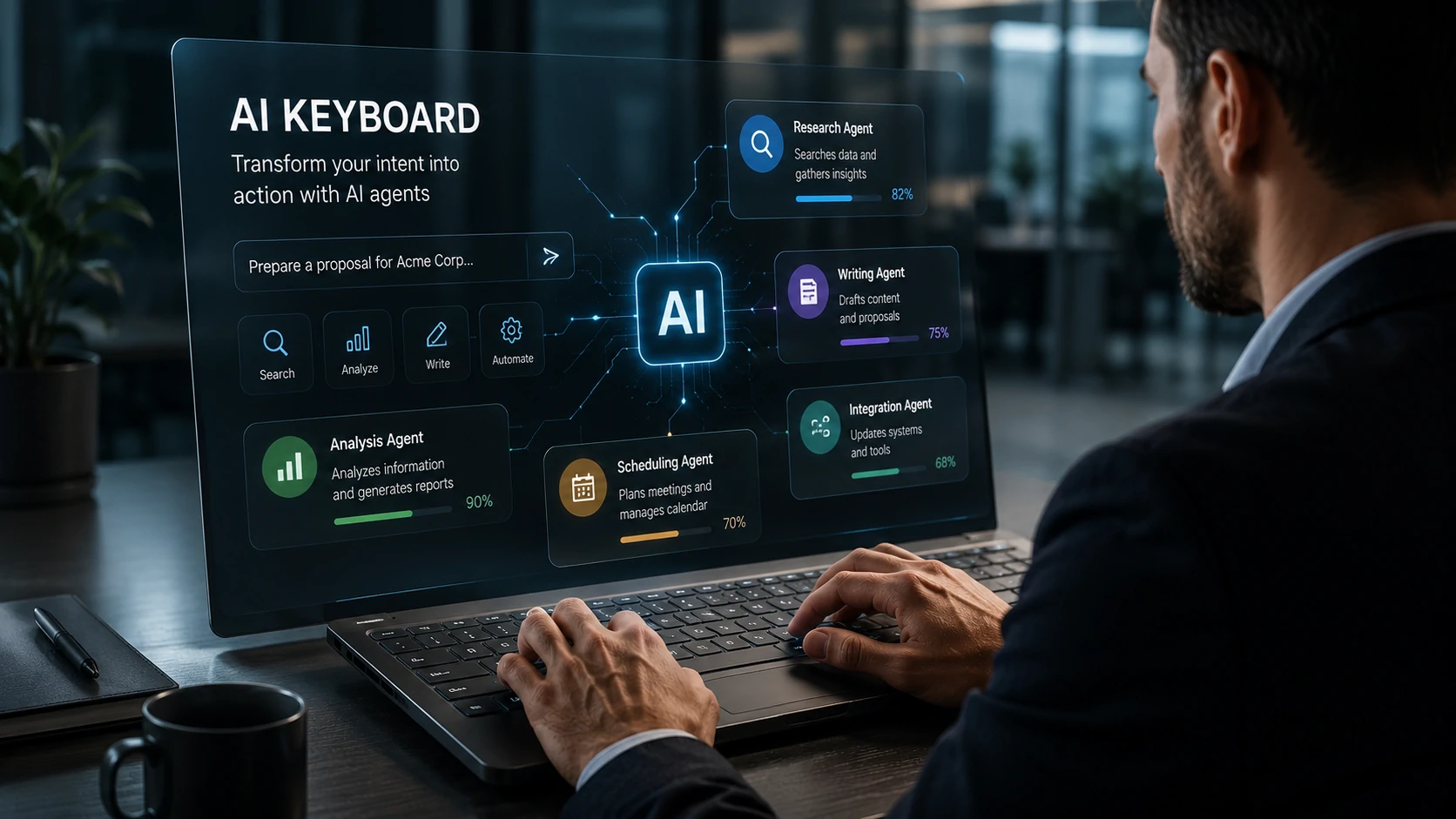
An AI-first interface designed to transform simple prompts into complete workflows executed by autonomous AI agents.
For years, interacting with artificial intelligence meant typing prompts into a chat window.
As AI agents become increasingly capable of handling complex business operations, this interaction model begins to reveal important limitations.
Managing long-running tasks, coordinating multiple agents and supervising autonomous workflows requires a far more sophisticated interface.
That is precisely where the concept of AI Keyboard enters the conversation.
An Interface Built for AI Agents
Rather than sending isolated prompts to a language model, AI Keyboard is designed to understand user intent, organize instructions and distribute responsibilities across multiple specialized agents.
Instead of talking to a single chatbot, professionals could oversee an ecosystem of intelligent systems capable of completing entire business processes.
Beyond Autocomplete
Today’s intelligent keyboards already offer predictive text, grammar correction and AI-assisted writing.
The vision behind OpenAI’s AI Keyboard extends much further by transforming the keyboard into an operational layer capable of launching workflows, summarizing documents, retrieving information, generating content and coordinating autonomous execution.
This evolution aligns closely with the enterprise AI strategy discussed in Why ChatGPT Work Marks the Beginning of the AI Agent Era for Enterprise Productivity.
Why AI Agents Need a New Type of Interface
Modern language models have evolved dramatically, yet the user experience has changed very little.
Most professionals still interact with AI exactly as they did a few years ago.
That simplicity becomes a bottleneck when organizations begin deploying multiple autonomous agents simultaneously.
The Coordination Challenge
Inside a company, different agents may specialize in entirely different responsibilities.
One agent gathers information.
Another writes reports.
Another analyzes documents.
Another updates enterprise systems.
Managing every step through isolated conversations quickly becomes inefficient.
The Keyboard Becomes a Command Center
Instead of serving merely as a text input device, AI Keyboard could evolve into a coordination layer responsible for prioritizing objectives, monitoring execution and orchestrating specialized AI agents automatically.
This broader trend complements the analysis published by Notícia Tech in How AI Agents Are Transforming Business Process Automation Beyond ChatGPT Work.
How AI Keyboard Could Transform Enterprise Productivity
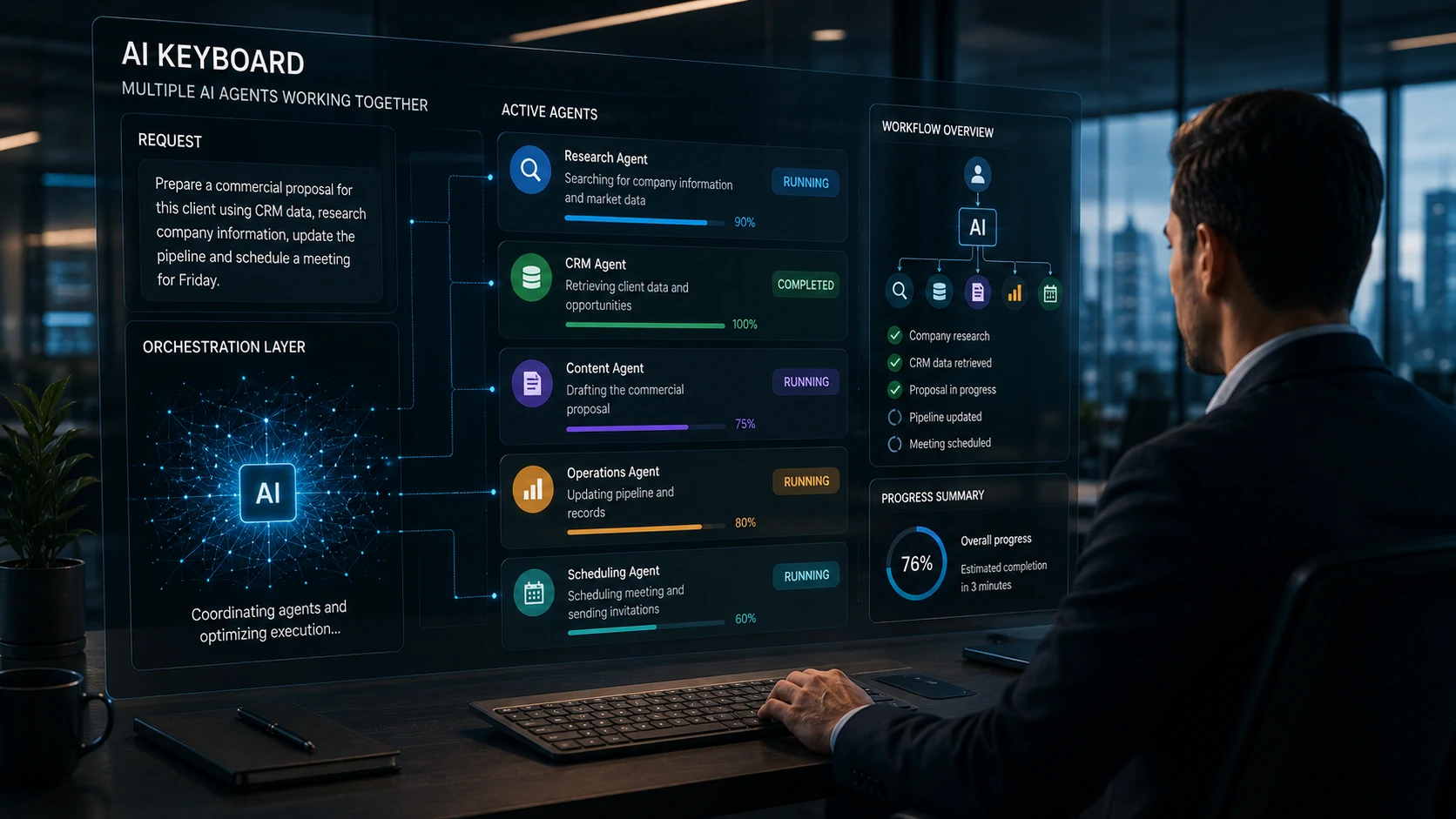
AI Keyboard could become the primary interface for coordinating multiple AI agents across enterprise operations.
As AI agents evolve beyond answering questions and begin executing complete business workflows, the way professionals interact with artificial intelligence must also change.
Instead of managing individual prompts, employees may simply define an objective while specialized agents collaborate behind the scenes.
Smarter Business Workflows
Imagine a sales manager typing:
“Prepare a proposal for this client using CRM data, research the company, update the sales pipeline and schedule a meeting for next Friday.”
Rather than generating only a written response, different AI agents could automatically:
- retrieve information from the CRM;
- research public company data;
- draft the proposal;
- update the sales pipeline;
- schedule the meeting.
From the user’s perspective, everything happens through a single interface while multiple autonomous systems execute the work simultaneously.
Fewer Commands, Better Results
This approach significantly reduces the need to switch between multiple applications throughout the workday.
Instead of opening several tools, professionals interact with a unified AI interface capable of orchestrating every stage of the workflow.
Organizations interested in AI-powered sales automation may also find value in What Is AI SDR and How to Build an AI Agent System for B2B Lead Generation. This complementary strategy demonstrates how specialized AI agents can automate prospecting and lead qualification.
Companies already investing in automation platforms will likely integrate AI Keyboard into their existing ecosystems, allowing employees to coordinate increasingly sophisticated AI workflows without fundamentally changing their technology stack.
The Future of Intelligent Interfaces Goes Beyond Chatbots
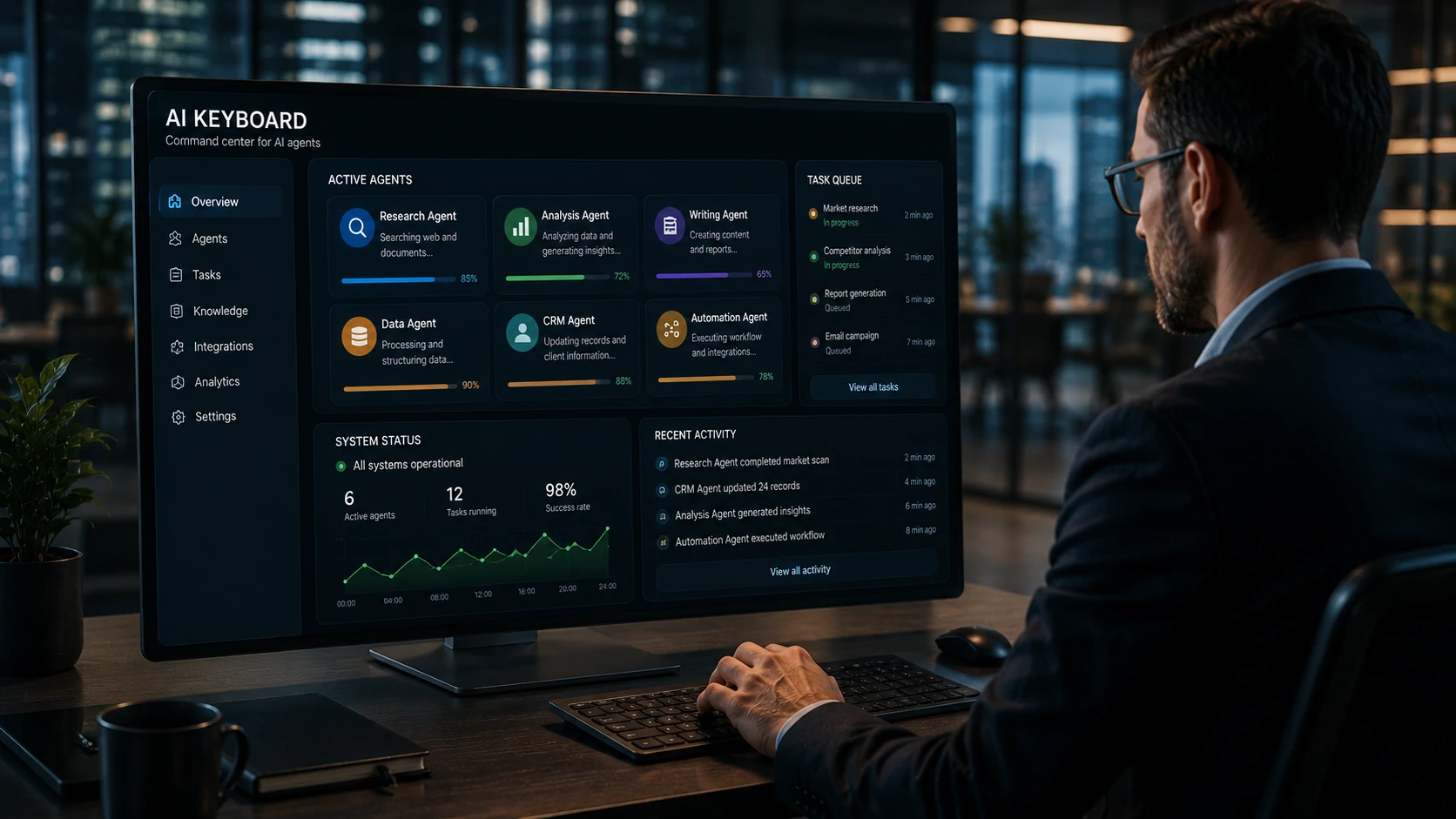
The next generation of enterprise interfaces may coordinate AI agents instead of simply displaying chatbot conversations.
The emergence of AI Keyboard highlights that the competition in artificial intelligence is no longer limited to building better language models.
The next battlefield is becoming the interface itself.
The Keyboard Is No Longer Just a Keyboard
For decades, keyboards changed very little.
Manufacturers focused on materials, ergonomics and typing comfort.
The AI era introduces a completely different role.
Instead of serving only as an input device, the keyboard may evolve into an intelligent orchestration layer capable of interpreting business goals, coordinating autonomous agents and supervising complex workflows.
This evolution brings enterprise computing closer to the way professionals actually work: defining objectives rather than manually executing every individual step.
A New Chapter for Enterprise Computing
Although OpenAI has not yet revealed every implementation detail, the strategic direction appears increasingly clear.
As companies including OpenAI, Microsoft, Google and Anthropic continue investing in autonomous AI agents, interfaces such as AI Keyboard are likely to become strategic assets for enterprise software.
For businesses, this shift could mean spending less time navigating applications and more time defining objectives while intelligent agents execute the operational work.
Over the next several years, organizations may evaluate AI systems not only by the quality of their answers but by their ability to transform a single instruction into a secure, autonomous and fully integrated business workflow.
Comentários
Os comentários utilizam autenticação via GitHub para manter um ambiente mais qualificado, seguro e livre de spam.
Entrar ou criar conta no GitHub