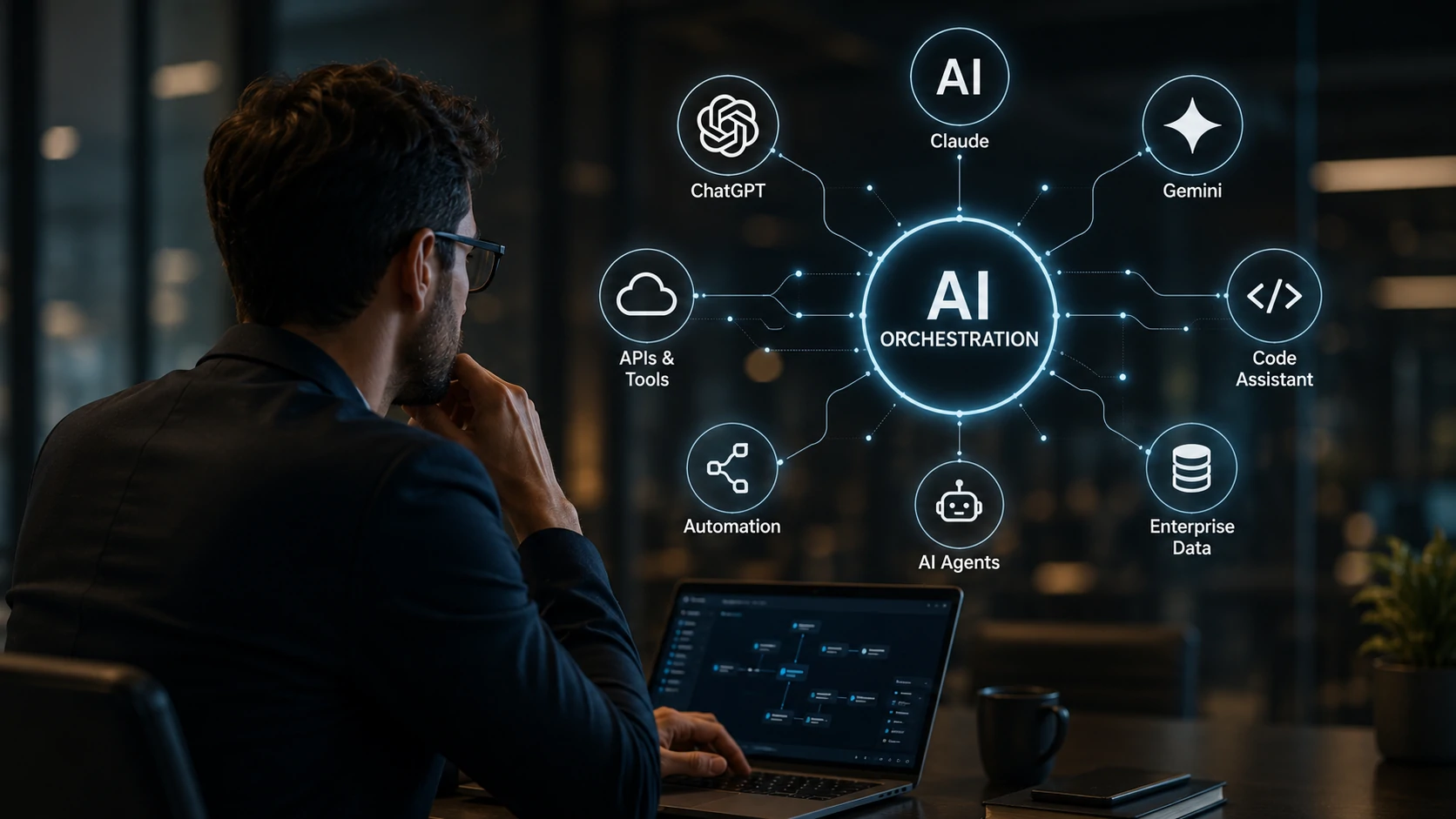
Businesses are no longer asking which artificial intelligence model is the best. The new priority is learning how to combine multiple models, tools and AI agents into a single intelligent architecture. That shift has brought AI Orchestration to the forefront as one of the most important developments in enterprise artificial intelligence.
During the early years of generative AI, competition centered on a simple question: which model produced the best responses?
Today, that question is becoming far less important.
Organizations have realized that no single AI model excels at every task. Some deliver stronger reasoning capabilities, while others provide lower operating costs, faster responses or deeper integration with enterprise software.
As a result, businesses are rapidly adopting AI Orchestration, an architectural approach that coordinates multiple artificial intelligence models simultaneously, automatically selecting the most appropriate one for every task.
Rather than choosing between ChatGPT, Claude, Gemini or open-source models, organizations are increasingly building environments where all of these technologies work together.
What Is AI Orchestration?
AI Orchestration is a software layer responsible for coordinating multiple artificial intelligence components within a unified architecture.
Instead of sending every request to a single model, the orchestration platform automatically determines which service should execute each task.
That decision may take into account factors such as:
- inference cost;
- response latency;
- expected quality;
- task complexity;
- service availability;
- security requirements;
- internal governance policies.
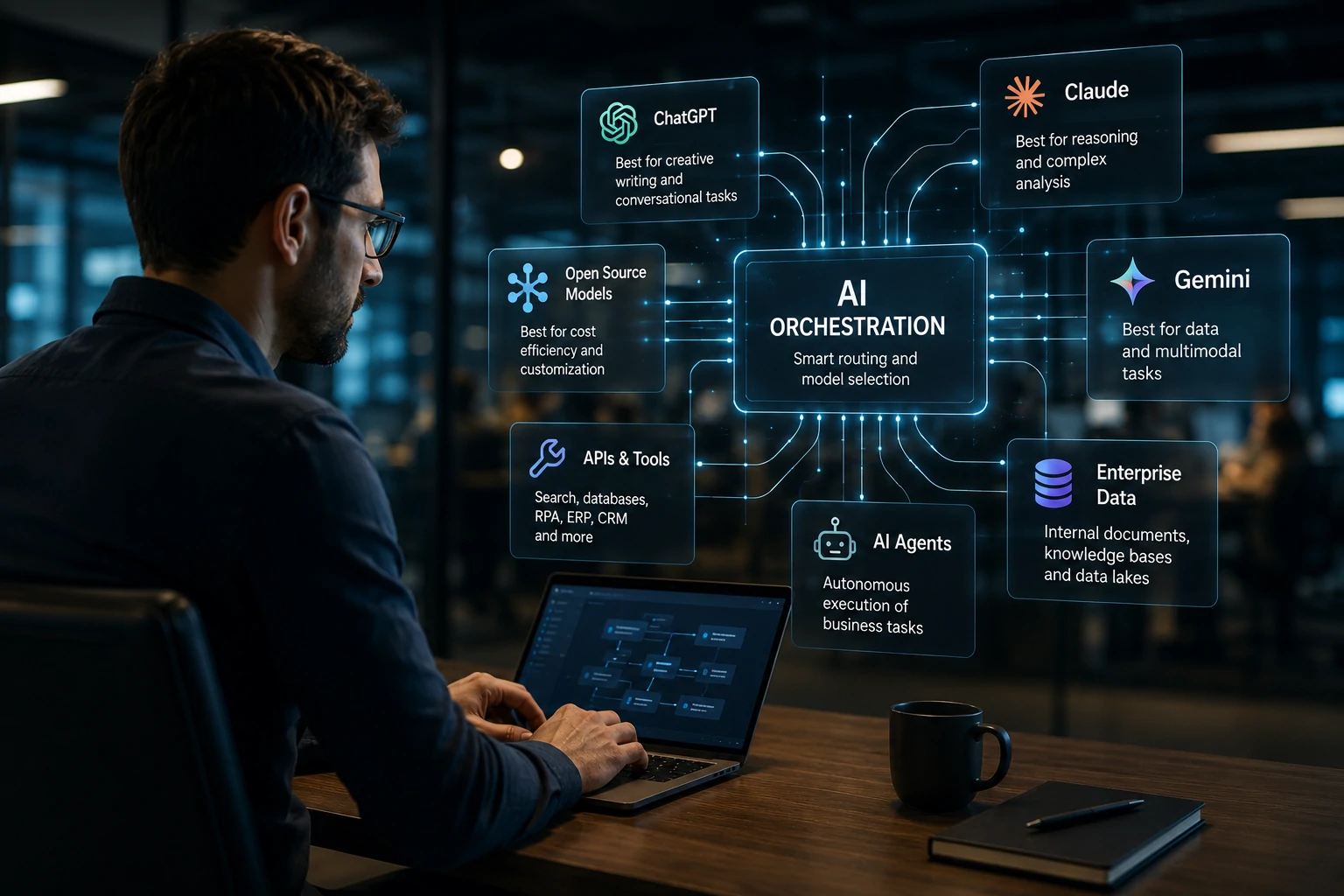
In many ways, AI Orchestration functions like the conductor of an orchestra.
It does not perform the music.
Instead, it coordinates every instrument so they work together efficiently.
Likewise, an orchestration layer coordinates language models, AI agents, APIs, enterprise systems, databases and automation platforms into a single intelligent workflow.
Why Businesses Are Moving Beyond a Single AI Model
Most early enterprise AI projects relied on just one foundation model.
That approach worked well when artificial intelligence was primarily used for straightforward tasks such as text generation or basic customer support.
Today’s enterprise workflows, however, are significantly more sophisticated.
A single request may involve:
- querying enterprise databases;
- retrieving internal documentation;
- performing legal analysis;
- generating software code;
- producing business content;
- requesting human approval;
- updating CRM platforms;
- triggering ERP processes.
Each of these activities may be better handled by a different AI model or service.
Cost has also become a critical consideration.
Processing millions of daily requests through the most expensive model is rarely sustainable at enterprise scale.
AI Orchestration addresses this challenge by automatically routing every task to the most appropriate resource.
The result is lower operating costs, improved performance and significantly greater scalability.
How Does a Multi-Model AI Architecture Work?
A multi-model architecture allows several artificial intelligence systems to work together within a coordinated workflow.
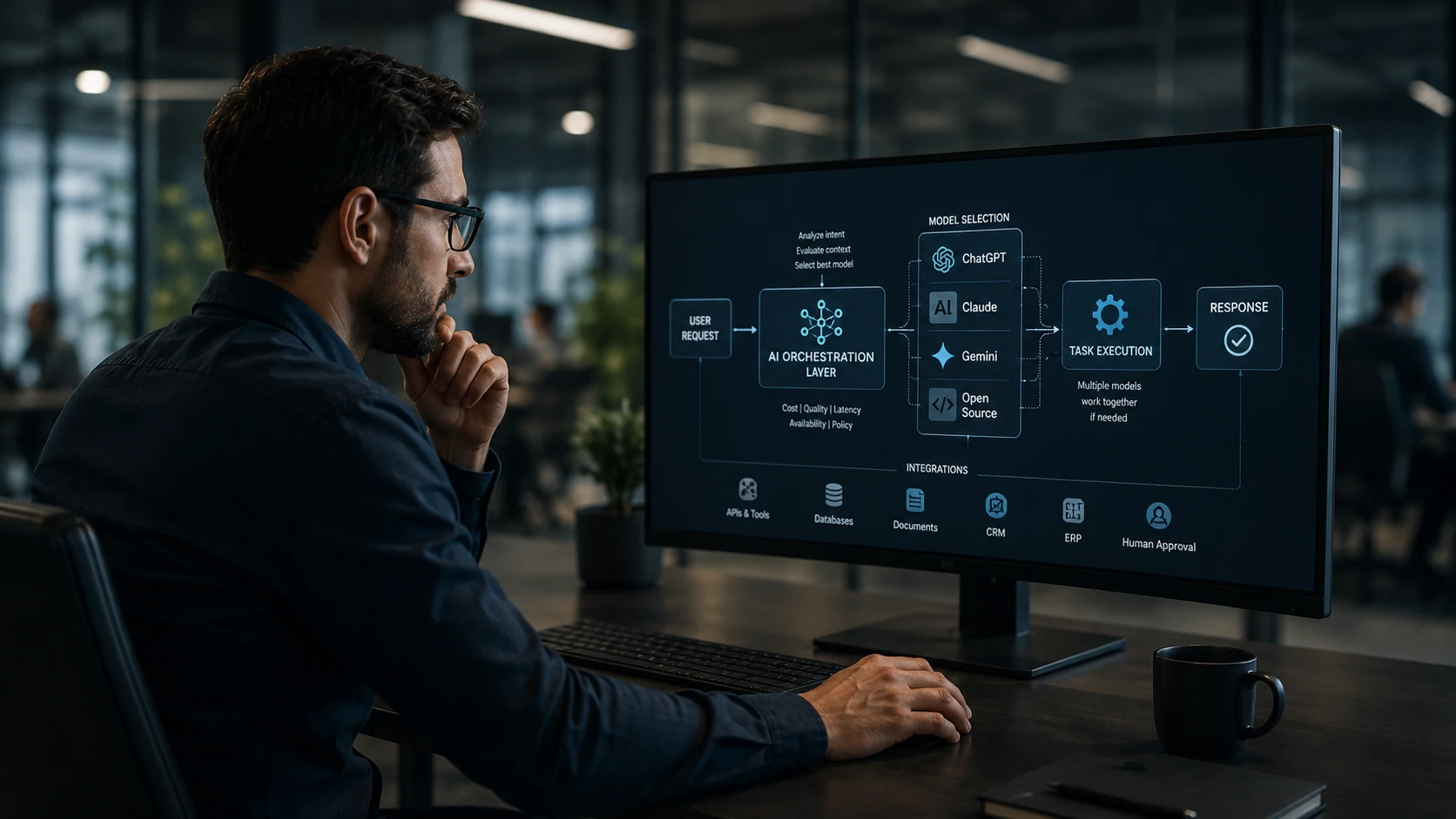
A typical orchestration process follows these steps:
A user submits a request.
The AI Orchestration layer analyzes the objective.
Factors such as cost, latency, context and expected quality are evaluated.
The system automatically selects the most appropriate AI model.
If necessary, multiple models collaborate sequentially.
The final response is consolidated before being delivered to the user.
In modern enterprise environments, this entire decision-making process often happens within milliseconds without requiring any human intervention.
This intelligent routing capability is what distinguishes a true orchestration platform from a simple collection of connected APIs.
Where Do ChatGPT, Claude, Gemini and Open-Source Models Fit In?
One of the biggest misconceptions in enterprise AI is the belief that there is a single model capable of handling every business scenario.
In reality, each model has distinct strengths.
For example:
- advanced reasoning models are well suited for strategic analysis;
- lightweight models excel at repetitive, high-volume tasks with lower operating costs;
- specialized models may outperform others in coding, research or translation;
- open-source models provide greater control over privacy, customization and infrastructure.
AI Orchestration combines these capabilities within a single operational workflow.
A single request may begin with an inexpensive model, move to a reasoning-focused model for complex analysis and finish with another model responsible for quality assurance or formatting.
This flexibility dramatically improves operational efficiency while allowing organizations to optimize both cost and performance.
AI Orchestration Benefits for Cost Optimization
Reducing operating costs has become one of the strongest business drivers behind AI Orchestration.

Without an orchestration layer, every request is typically processed by the same AI model regardless of its complexity.
This approach often wastes computing resources.
Some of the most significant financial benefits include:
- routing simple tasks to lower-cost models;
- reducing dependence on premium API calls;
- automatically balancing workloads across providers;
- minimizing downtime caused by provider outages;
- improving infrastructure utilization.
Another strategic advantage is vendor independence.
Organizations become less dependent on a single AI provider, reducing the risks associated with vendor lock-in and making future technology adoption significantly easier.
Practical Enterprise Use Cases
AI Orchestration can support virtually any enterprise workflow involving artificial intelligence.
Some of the most common applications include:
Customer Service
The system identifies user intent, retrieves information from internal knowledge bases, selects the most appropriate AI model and automatically records every interaction within the company’s CRM.
B2B Sales
AI agents qualify leads, analyze customer history, prepare proposals, generate documentation and route high-value opportunities to human sales representatives.
Software Development
Automated workflows distribute work among different AI models for code generation, documentation, testing, debugging and security validation.
Legal Operations
The orchestration platform retrieves contracts, reviews regulations, summarizes legal documents and prepares preliminary analyses before attorneys perform their final review.
Across every scenario, the selection of the most appropriate AI model happens automatically.
AI Orchestration, MCP and AI Agents
Although these concepts are frequently discussed together, they serve different purposes within an enterprise AI architecture.
AI Orchestration acts as the coordination layer.
AI agents execute individual autonomous tasks.
Meanwhile, the Model Context Protocol (MCP) standardizes communication between AI models, enterprise tools and external data sources.
A modern enterprise architecture typically operates as follows:
- MCP connects systems and external services;
- AI agents execute specialized business tasks;
- AI Orchestration determines which agent should run, when it should execute and which AI model should power each operation.
Together, these technologies create intelligent workflows that are more scalable, resilient and maintainable than traditional AI deployments.
The Future of Enterprise AI
Enterprise artificial intelligence is moving beyond competition between individual foundation models.
Competitive advantage will increasingly depend on an organization’s ability to integrate multiple AI technologies into a unified architecture.
Future enterprise environments are expected to combine multiple foundation models, specialized AI agents, external tools and enterprise data sources through a centralized orchestration layer.
This architectural approach gives businesses the flexibility to adopt new technologies without rebuilding their existing AI infrastructure.
Instead of choosing a single winner among ChatGPT, Claude, Gemini or open-source models, organizations are embracing environments where every model can contribute according to its strengths.
The decision is no longer made by the user.
It is made automatically by the architecture itself.
Conclusion
AI Orchestration represents a fundamental shift in how organizations deploy artificial intelligence.
Rather than relying on a single AI model, businesses are building intelligent architectures capable of automatically selecting the best technology for every task.
This approach reduces costs, improves scalability, strengthens governance and creates a far more resilient AI infrastructure prepared for the rapid pace of technological change.
As enterprise AI continues to evolve, orchestration is positioned to become one of the foundational components of next-generation artificial intelligence platforms.
Comentários
Os comentários utilizam autenticação via GitHub para manter um ambiente mais qualificado, seguro e livre de spam.
Entrar ou criar conta no GitHub