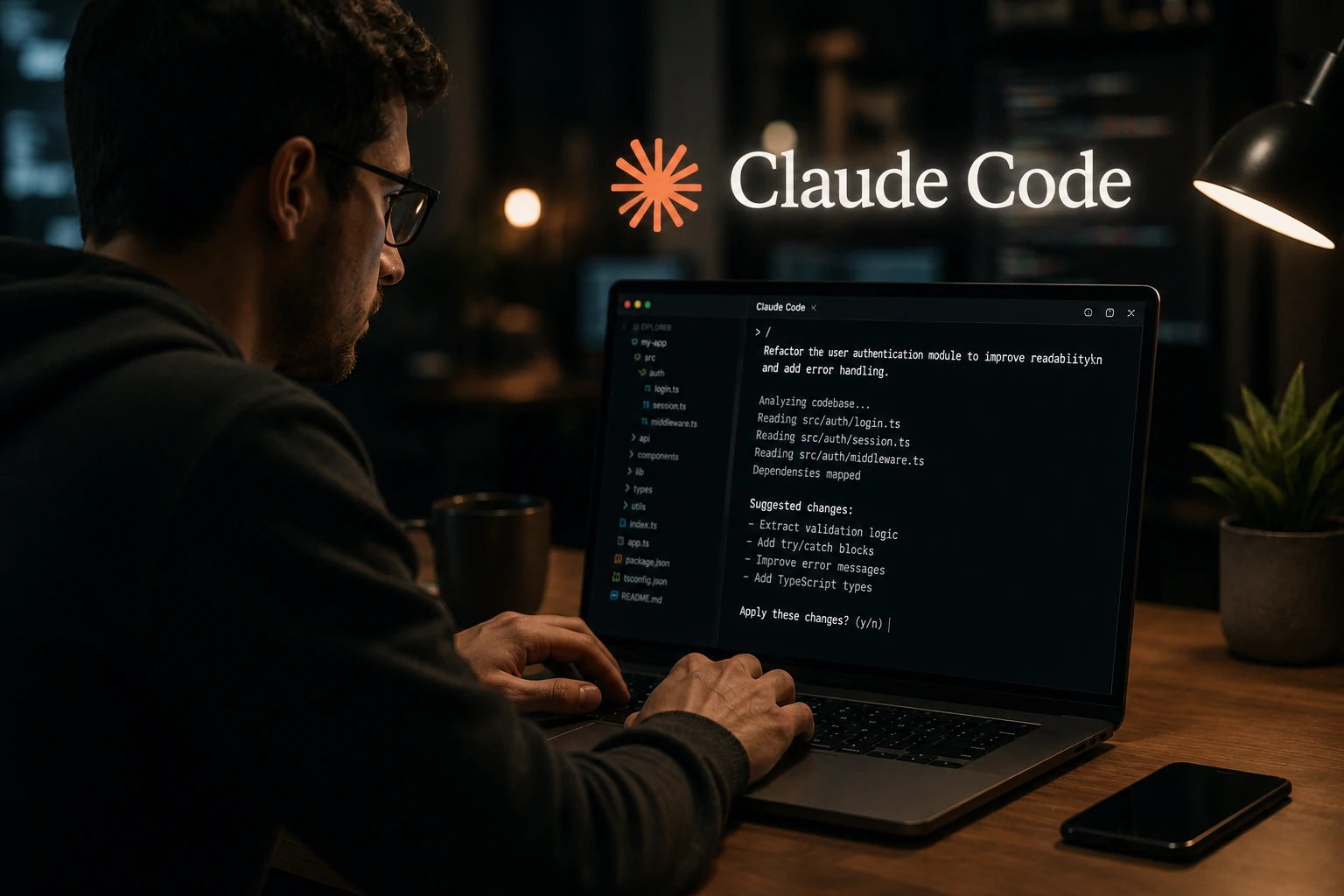
As AI agents evolve from answering questions to completing complex tasks, a new generation of developer tools is emerging. Claude Code, created by Anthropic, brings artificial intelligence directly into the software development workflow, allowing engineers to collaborate with AI without leaving their terminal.
The rapid growth of Generative AI has introduced dozens of coding assistants. However, few solutions have been designed to understand entire software projects while remaining part of the development workflow from start to finish.
This is where Claude Code stands apart. Rather than generating isolated snippets of code, it acts as an intelligent engineering assistant capable of understanding architecture, documentation, project structure and development goals.
What Is Claude Code?

Claude Code brings Anthropic’s AI models directly into the development environment, enabling natural interaction with software projects.
Claude Code is an AI-powered development tool created by Anthropic that integrates Claude models directly into the command-line development environment.
Instead of copying code into a chatbot, developers interact with AI while it analyzes the local repository, understands project dependencies, interprets files and suggests contextual improvements.
This approach transforms AI from a simple coding assistant into a collaborative software engineering partner.
Unlike traditional coding assistants, Claude Code is designed to remain involved throughout the entire software development lifecycle.
Understanding the Entire Codebase
By accessing repository context, the tool can understand relationships between files, frameworks, documentation and architectural patterns.
This broader perspective leads to more accurate recommendations while reducing generic responses.
Natural Language Development
Developers can describe programming tasks using everyday language.
Examples include:
- building APIs;
- explaining complex functions;
- refactoring modules;
- identifying bugs;
- generating automated tests;
- creating technical documentation.
How Is Claude Code Changing Modern Software Development?

Rather than replacing engineers, Claude Code is designed to improve productivity throughout the software development lifecycle.
The biggest innovation behind Claude Code is how it changes the development workflow itself.
Instead of constantly switching between the IDE, browser and AI chatbot, developers remain inside their coding environment while collaborating with artificial intelligence.
This reduces context switching and significantly improves productivity.
The platform also supports multiple stages of software engineering.
Automating Repetitive Engineering Tasks
Software developers spend a considerable amount of time on repetitive work rather than solving complex technical problems.
Examples include:
- writing documentation;
- generating tests;
- reviewing code;
- organizing project files;
- explaining legacy systems.
These activities can be completed much faster with AI assistance.
Supporting Continuous Learning
Junior developers also benefit from the platform.
Rather than receiving code without explanation, they can ask detailed questions about architecture, algorithms and engineering best practices, making the learning process far more effective.
This evolution aligns with broader trends previously explored by Notícia Tech, including AI Fluency:
What Are the Main Benefits of Claude Code for Businesses?

Businesses are embedding AI directly into software development workflows to increase productivity, reduce costs and speed up innovation.
Claude Code delivers value far beyond automatic code generation. Its greatest advantage lies in its ability to accelerate software engineering while maintaining context throughout the entire development process.
For enterprise development teams, this translates into faster delivery cycles, less time spent on repetitive work and greater focus on high-value engineering tasks.
As organizations increasingly adopt AI agents and automation platforms, tools such as Claude Code are expected to become a core component of modern software development infrastructure.
Higher Team Productivity
Some of the most significant business benefits include:
- shorter software development cycles;
- automated technical documentation;
- AI-assisted test generation;
- easier maintenance of legacy applications;
- faster understanding of large codebases;
- improved onboarding for new developers.
These capabilities allow engineering teams to work more efficiently without replacing human expertise.
Integration with the Future of Enterprise AI
The software industry is moving toward ecosystems powered by multiple specialized AI agents.
Within this environment, Claude Code is expected to integrate with technologies such as Model Context Protocol (MCP), automation platforms and modern DevOps pipelines, enabling increasingly autonomous software engineering workflows.
This evolution complements trends previously covered by Notícia Tech in:
Claude Code Signals the Next Stage of Software Engineering
Claude Code should not be viewed as just another AI coding assistant.
Instead, it represents a fundamental shift in how software professionals interact with development tools. Rather than using AI only to answer isolated questions, developers can collaborate with intelligent systems capable of understanding complete projects and contributing throughout the entire software lifecycle.
This transformation reflects a broader evolution across the technology industry. Software engineering is increasingly moving toward a collaborative model in which human developers define architecture, business logic and strategic decisions while AI agents execute many operational tasks.
For businesses, this means faster product delivery, improved code quality and greater development efficiency. For professionals, it highlights the importance of acquiring new skills focused on collaborating effectively with artificial intelligence while maintaining technical judgment and critical thinking.
Instead of replacing software engineers, Claude Code demonstrates how the future of software development will likely be built by hybrid teams where human expertise and AI agents work together to create increasingly sophisticated applications.
Comentários
Os comentários utilizam autenticação via GitHub para manter um ambiente mais qualificado, seguro e livre de spam.
Entrar ou criar conta no GitHub