
For years, business automation meant eliminating repetitive tasks through predefined rules. Today, organizations are moving toward a new generation of intelligent workflows capable of interpreting information, making contextual decisions, and continuously adapting business operations. This shift is becoming one of the most significant productivity opportunities in enterprise technology.
AI Process Automation introduces the next generation of enterprise automation
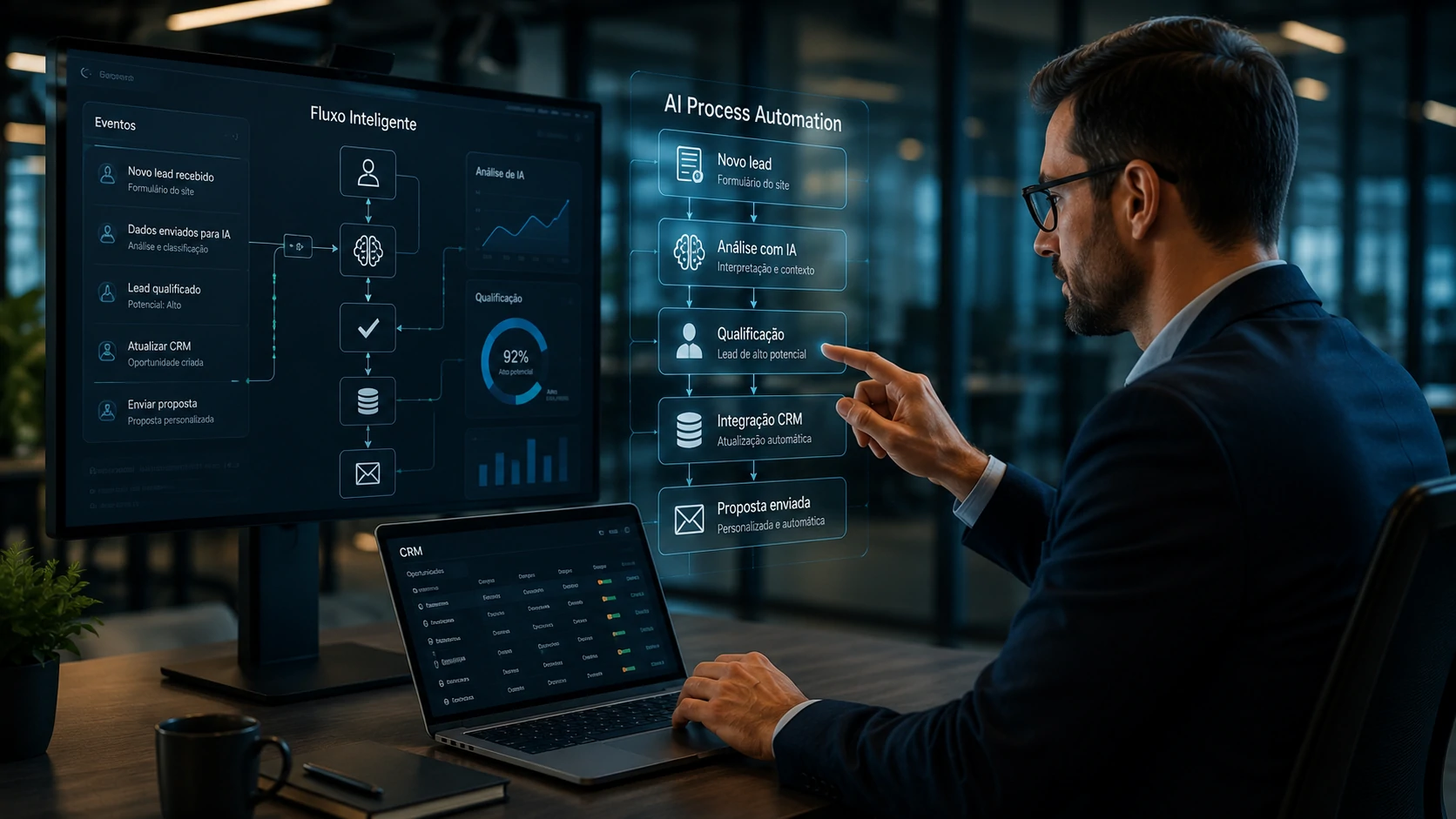
Intelligent workflows allow enterprise systems to share context, coordinate decisions, and execute increasingly autonomous business operations.
The rapid evolution of Artificial Intelligence has fundamentally changed what business automation means. Instead of simply executing predefined instructions, modern automation platforms can now understand natural language, analyze documents, classify information, and determine the most appropriate action without relying exclusively on fixed rules.
This new approach has become known as AI Process Automation, combining Generative AI, workflow automation, enterprise APIs, and system integration to create far more intelligent business operations.
Rather than depending entirely on human intervention for operational decisions, organizations can now automate significant portions of complex workflows while maintaining appropriate human oversight.
From rule-based automation to intelligent decision-making
For many years, Robotic Process Automation (RPA) successfully automated repetitive business activities.
However, traditional automation often failed whenever an unexpected situation required interpretation or contextual reasoning.
The emergence of models such as GPT, Claude, and Gemini has dramatically expanded automation capabilities. Instead of simply following predefined rules, AI-powered systems can understand intent, interpret business context, and dynamically adapt their responses.
Intelligence becomes part of the business process
The biggest advantage of AI Process Automation is not simply performing tasks automatically.
Its real value lies in embedding intelligence directly into operational workflows.
For example, an automated process can receive an email, determine its purpose, retrieve customer information from a CRM, generate a personalized response, update multiple enterprise systems, and escalate the request to a human employee only when necessary.
This evolution complements concepts previously explored by Notícia Tech, including What Is AI Orchestration? Replacing AI Model Competition for Business, where orchestrating multiple AI models becomes as important as the models themselves. :contentReference[oaicite:0]{index=0}
How a modern AI Process Automation architecture works
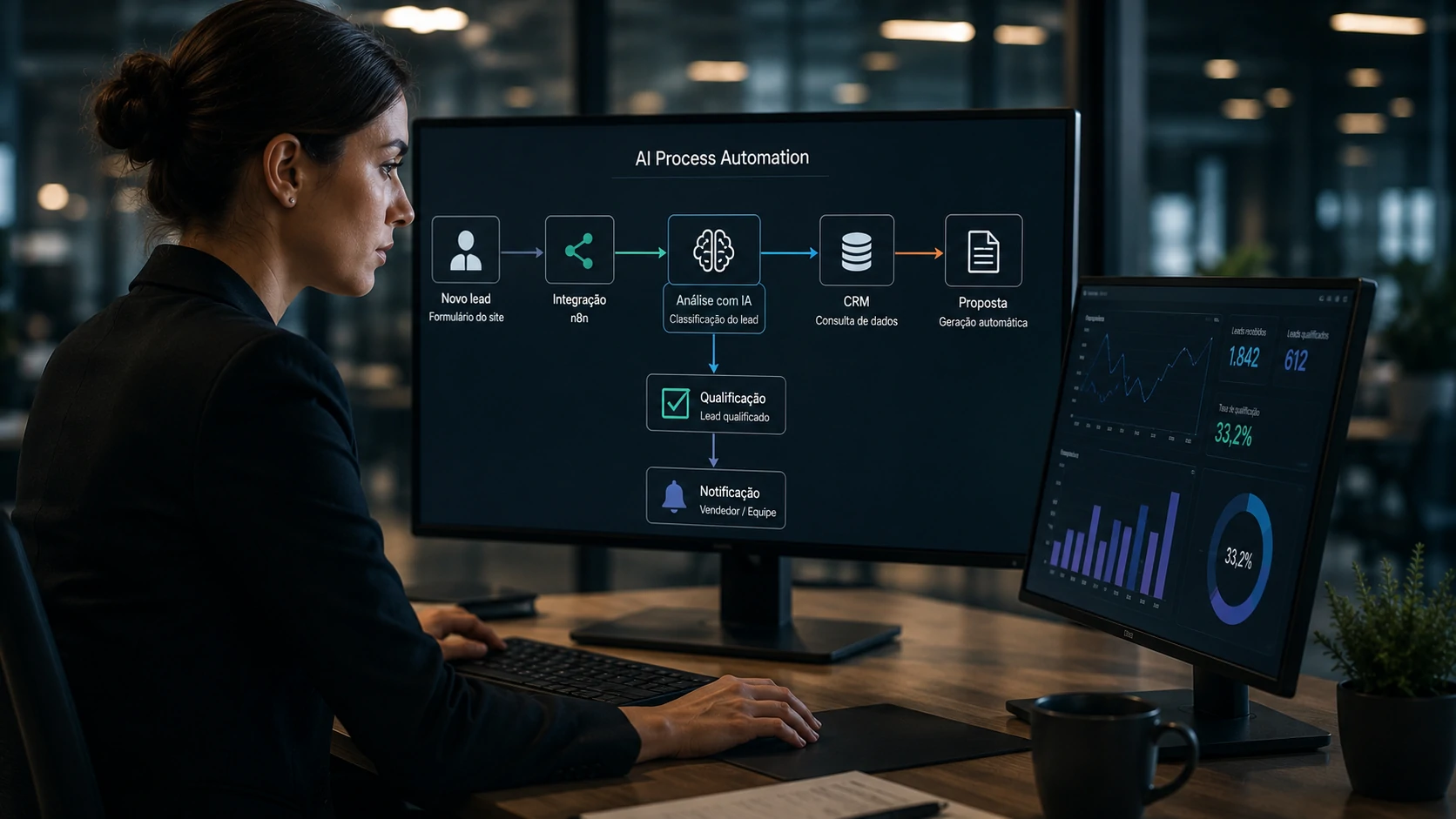
AI models, enterprise applications, CRMs, APIs, and databases work together to automate complete business processes instead of isolated tasks.
Unlike traditional automation, modern AI workflows combine multiple technologies operating simultaneously throughout the execution of a process.
Instead of following a simple “if X happens, perform Y” logic, these architectures continuously analyze context before making operational decisions.
A practical example of an intelligent workflow
A modern enterprise workflow may operate as follows:
- A customer submits a form through the company’s website.
- n8n detects the new submission.
- Customer information is sent to the OpenAI API.
- The AI evaluates and classifies the lead.
- The workflow consults the company’s CRM.
- If the lead meets qualification criteria, a personalized proposal is automatically generated.
- Sales representatives receive only high-value opportunities with the greatest probability of conversion.
In this scenario, Artificial Intelligence participates directly in decision-making, while the automation platform orchestrates communication between enterprise systems.
Example prompt used inside the workflow
You are a sales analyst.

Analyze the lead information below.

Classify the purchase potential as High, Medium, or Low.

Explain the reasoning behind your classification.

Recommend the most appropriate next sales action.

Return the response as valid JSON.
This architecture significantly increases operational efficiency while reducing response times, eliminating repetitive manual work, and improving customer experience.
Organizations already investing in AI-powered CRM platforms can further enhance these capabilities by integrating workflows similar to those described in How to Implement an AI CRM for Business: A Practical Guide.
Where AI Process Automation creates the greatest business impact

Intelligent workflows are connecting departments that once operated independently, reducing bottlenecks and significantly improving operational efficiency.
Although many organizations associate AI Process Automation primarily with customer service, its impact extends across virtually every business function. Companies are increasingly deploying intelligent workflows to automate complex processes that previously required constant collaboration between multiple departments.
As Generative AI platforms become more accurate and reliable, organizations can automate complete business workflows involving data analysis, contextual decision-making, document processing, and enterprise system integration.
The result is a faster, more scalable, and more consistent operating model capable of handling growing business complexity without proportionally increasing operational costs.
Business functions benefiting the most
Some of the most common enterprise use cases include:
- Sales: automated lead qualification, proposal generation, and CRM updates.
- Finance: invoice processing, document validation, reconciliation, and financial approvals.
- Human Resources: resume screening, candidate ranking, interview scheduling, and reporting.
- Customer Support: ticket classification, intelligent responses, and automated case routing.
- Operations: workflow monitoring, task orchestration, system integration, and operational reporting.
Across virtually every department, Artificial Intelligence eliminates repetitive administrative work while allowing employees to focus on strategic initiatives, customer relationships, and business growth.
Human-in-the-Loop remains essential
Despite the rapid evolution of AI technologies, organizations should not remove human supervision from critical business processes.
Large Language Models can still misinterpret information, produce inaccurate responses, or generate hallucinations when operating with incomplete or ambiguous data.
For this reason, the Human-in-the-Loop approach remains one of the most important principles of responsible AI adoption.
The most effective enterprise strategy combines intelligent automation with human oversight. AI performs operational and repetitive activities, while professionals continue making critical decisions involving finance, legal matters, compliance, customer relationships, and corporate governance.
This balance enables organizations to increase productivity without compromising security, accountability, or decision quality.
Why AI Process Automation will accelerate enterprise digital transformation
AI Process Automation represents the natural evolution of the digital transformation initiatives that began with Robotic Process Automation, enterprise integration platforms, and cloud computing. The fundamental difference is that intelligence is no longer an isolated capability—it becomes embedded throughout the entire business process.
Organizations adopting AI Process Automation today are positioned to reduce operational costs, improve customer responsiveness, increase scalability, and build more adaptive business operations. At the same time, companies must establish governance policies, auditing mechanisms, and human oversight to ensure AI systems remain transparent, secure, and aligned with business objectives.
Rather than replacing traditional automation technologies, AI Process Automation expands their capabilities by connecting people, enterprise data, AI models, and business applications into a unified intelligent workflow. The challenge for technology leaders is no longer simply automating tasks—it is designing business processes capable of learning, adapting, and continuously improving over time.
Companies that embrace this transition early will be better prepared for the next phase of enterprise digital transformation, where automation no longer follows instructions alone but actively contributes to business decision-making and long-term competitive advantage.
Comentários
Os comentários utilizam autenticação via GitHub para manter um ambiente mais qualificado, seguro e livre de spam.
Entrar ou criar conta no GitHub